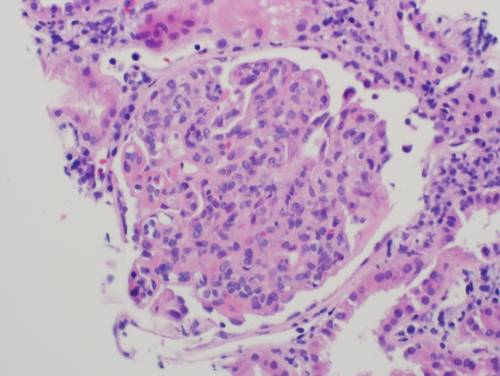
A 35 year-old Caucasian male presents with persistent swelling of both legs associated with dark colored urine for two months. He went to an emergency room 2 months ago for these complaints and was told that he has some protein and blood in the urine. He was treated with 3 days of levofloxacin. There is no other past medical history. No history of skin rash or joint swelling. On examination the blood pressure was 130/85 mm Hg and there was bilateral 1+ pedal edema. Rest of the physical examination was normal. Urine analysis showed 3+ proteinuria, 10-15 RBCs per high-power field, and occasional RBC cast. The BUN was 10 mg/dL, serum creatinine was 0.9 mg/dL. Antistreptolysin was negative, C3 level is decreased and C4 level is normal. Antinuclear antibodies, ANCA, hepatitis B and C serology were negative. 24-hour urine collection showed 2 g proteinuria and a kidney biopsy was performed. On light microscopy, kidney biopsy showed increase in the mesangial matrix and cellularity and glomerular basement membrane appeared irregularly thickened. Silver stain revealed duplication of glomerular basement membrane in multiple glomeruli. Immunofluorescence showed positive staining for C3, but negative for IgG, IgM and IgA. Electron microscopy revealed electron-dense deposits in the mesangium and sub-endothelial area.
What is the most likely diagnosis?
| A. Acute poststreptococcal glomerular nephritis | |
| B. Diffuse proliferative lupus nephritis | |
| C. Dense deposit disease | |
|
|
D. C3 glomerulopathy |
| E. |
|
|
Copyright © ABIM Exam World
Created On: 09/12/2017
Last Modified: 03/07/2021
A 35 year-old Caucasian male presents with persistent swelling of both legs associated with dark colored urine for two months. He went to an emergency room 2 months ago for these complaints and was told that he has some protein and blood in the urine. He was treated with 3 days of levofloxacin. There is no other past medical history. No history of skin rash or joint swelling. On examination the blood pressure was 130/85 mm Hg and there was bilateral 1+ pedal edema. Rest of the physical examination was normal. Urine analysis showed 3+ proteinuria, 10-15 RBCs per high-power field, and occasional RBC cast. The BUN was 10 mg/dL, serum creatinine was 0.9 mg/dL. Antistreptolysin was negative, C3 level is decreased and C4 level is normal. Antinuclear antibodies, ANCA, hepatitis B and C serology were negative. 24-hour urine collection showed 2 g proteinuria and a kidney biopsy was performed. On light microscopy, kidney biopsy showed increase in the mesangial matrix and cellularity and glomerular basement membrane appeared irregularly thickened. Silver stain revealed duplication of glomerular basement membrane in multiple glomeruli. Immunofluorescence showed positive staining for C3, but negative for IgG, IgM and IgA. Electron microscopy revealed electron-dense deposits in the mesangium and sub-endothelial area.
What is the most likely diagnosis?
| A. Acute poststreptococcal glomerular nephritis | |
| B. Diffuse proliferative lupus nephritis | |
| C. Dense deposit disease | |
|
|
D. C3 glomerulopathy |
| E. |
|
|
Copyright © ABIM Exam World
Created On: 09/12/2017
Last Modified: 03/07/2021

A 25 year-old male comes to the physician complaining of flank pain and hematuria. He says the pain is constant and dull. There is no frequency, urgency or dysuria. He has a history of mental retardation and seizures. On physical exam his blood pressure is 140/90 mm Hg, and his pulse is 80 bpm. He has multiple yellow papules across his nose and cheeks and numerous areas of blanched skin spots on his face. A 2-3 cm hypopigmented macule is noted on the right arm. CT scan of the head was done as patient presented with seizures. CT head was reported normal. CT scan of the abdomen shows bilateral hypodense fat containing renal masses and cysts.
What is the MOST likely diagnosis associated with these findings?
| A. Von Hippel Lindau | |
| B. Sturge Weber Syndrome | |
|
|
C. Tuberous Sclerosis |
| D. Osler Weber Rendu | |
| E. Neurofibromatosis type 2 |
|
|
Copyright © ABIM Exam World
Created On: 09/13/2017
Last Modified: 12/30/2017
A 25 year-old male comes to the physician complaining of flank pain and hematuria. He says the pain is constant and dull. There is no frequency, urgency or dysuria. He has a history of mental retardation and seizures. On physical exam his blood pressure is 140/90 mm Hg, and his pulse is 80 bpm. He has multiple yellow papules across his nose and cheeks and numerous areas of blanched skin spots on his face. A 2-3 cm hypopigmented macule is noted on the right arm. CT scan of the head was done as patient presented with seizures. CT head was reported normal. CT scan of the abdomen shows bilateral hypodense fat containing renal masses and cysts.
What is the MOST likely diagnosis associated with these findings?
| A. Von Hippel Lindau | |
| B. Sturge Weber Syndrome | |
|
|
C. Tuberous Sclerosis |
| D. Osler Weber Rendu | |
| E. Neurofibromatosis type 2 |
|
|
Copyright © ABIM Exam World
Created On: 09/13/2017
Last Modified: 12/30/2017
A 15 year-old boy is brought to the ER by his foster mother who states that when she got home from work she noticed he was acting very strange. He had slurred speech and seemed confused. He appeared to be very uncoordinated and she was not sure if he fell or hit his head. She states that he is somewhat a troubled boy but doesn’t know much about his history as he has been in and out of the foster care system out of state. On physical exam, he is tachycardic and has tachypnoea. Pupils are dilated, but there is no nystagmus. A fundoscopic exam shows hyperemia of the optic disk. He is relatively uncooperative but not aggressive or hostile. When asked about suicidal thoughts he responds only with inaudible mumbling. His foster mother left for work 10 hours prior and assumed he left for school. She is not sure when these symptoms began or what may have initiated them. P is 105/ min, BP is 140/90 mm Hg, RR is 28/min, and T is 97.1 F. Laboratory examination is as follows:
Na 135 mEq/L
K 5.0 mEq/L
CL 105 mEq/L
BUN 19 mg/dL
Cr 1.3 mg/dL
HCO3 8 mEq/L
Glucose 100 mg/dL
pH 7.3
pO2 90 mmHg
pCO2 22 mmHg
Measured serum osmolarity 320 mmol/L
What is the next step in management?
| A. Gastric lavage | |
| B. N-acetylcystiene and activated charcoal | |
| C. Fomepizole | |
|
|
D. Fomepizole and Hemodialysis |
| E. Obtain serum levels of salycylate, methanol and ethylene glycol levels |
|
|
Copyright © ABIM Exam World
Created On: 09/13/2017
Last Modified: 12/30/2017
A 15 year-old boy is brought to the ER by his foster mother who states that when she got home from work she noticed he was acting very strange. He had slurred speech and seemed confused. He appeared to be very uncoordinated and she was not sure if he fell or hit his head. She states that he is somewhat a troubled boy but doesn’t know much about his history as he has been in and out of the foster care system out of state. On physical exam, he is tachycardic and has tachypnoea. Pupils are dilated, but there is no nystagmus. A fundoscopic exam shows hyperemia of the optic disk. He is relatively uncooperative but not aggressive or hostile. When asked about suicidal thoughts he responds only with inaudible mumbling. His foster mother left for work 10 hours prior and assumed he left for school. She is not sure when these symptoms began or what may have initiated them. P is 105/ min, BP is 140/90 mm Hg, RR is 28/min, and T is 97.1 F. Laboratory examination is as follows:
Na 135 mEq/L
K 5.0 mEq/L
CL 105 mEq/L
BUN 19 mg/dL
Cr 1.3 mg/dL
HCO3 8 mEq/L
Glucose 100 mg/dL
pH 7.3
pO2 90 mmHg
pCO2 22 mmHg
Measured serum osmolarity 320 mmol/L
What is the next step in management?
| A. Gastric lavage | |
| B. N-acetylcystiene and activated charcoal | |
| C. Fomepizole | |
|
|
D. Fomepizole and Hemodialysis |
| E. Obtain serum levels of salycylate, methanol and ethylene glycol levels |
|
|
Copyright © ABIM Exam World
Created On: 09/13/2017
Last Modified: 12/30/2017
All of the following are helpful in predicting AV Graft stenosis EXCEPT:
| A. Hyperpulsatility of the AV Graft | |
| B. Ruduced pulse augmentation | |
| C. Increased bleeding and clots | |
| D. Decreased KT/V | |
| E. Decreased Blood Flow rate | |
|
|
F. Surveillance of the graft |
|
|
Copyright © ABIM Exam World
Created On: 09/14/2017
Last Modified: 08/06/2018
All of the following are helpful in predicting AV Graft stenosis EXCEPT:
| A. Hyperpulsatility of the AV Graft | |
| B. Ruduced pulse augmentation | |
| C. Increased bleeding and clots | |
| D. Decreased KT/V | |
| E. Decreased Blood Flow rate | |
|
|
F. Surveillance of the graft |
|
|
Copyright © ABIM Exam World
Created On: 09/14/2017
Last Modified: 08/06/2018
A 25 year-old female is referred by her primary care provider for evaluation of hypertension and hypokalemia. The primary care provider has already started her on oral potassium, despite therapy her Potassium being 2.8 meq/L. Her blood pressure despite treatment with amlodipine and Lisinopril 154/96 mm of Hg. There is no renal bruit. Systemic and fundus examinations are normal. Her mother was also diagnosed with hypertension at an early age. Her brother died of a cerebrovascular accident 2 years ago. Laboratory findings are as follows:
Na 140
Potassium 2.8
Chloride 100
HCO3 26
BUN 15
Creatinine 0.8
Glucose 110
TSH and Cortisol are normal
ACTH elevated
Renin 0.7 (Low)
Aldosterone 48 (elevated)
Urinalysis:
Sodium 240 mEq/D
Potassium 98 mEq/D
Urinary 18-OH Cortisol and 18-oxocortisol are elevated.
The most appropriate treatment for this patient is:
| A. Steroids | |
| B. Spironolactone | |
|
|
C. Steroids + Spironolactone |
| D. Amiloride |
|
|
Copyright © ABIM Exam World
Created On: 09/20/2017
Last Modified: 08/06/2018
A 25 year-old female is referred by her primary care provider for evaluation of hypertension and hypokalemia. The primary care provider has already started her on oral potassium, despite therapy her Potassium being 2.8 meq/L. Her blood pressure despite treatment with amlodipine and Lisinopril 154/96 mm of Hg. There is no renal bruit. Systemic and fundus examinations are normal. Her mother was also diagnosed with hypertension at an early age. Her brother died of a cerebrovascular accident 2 years ago. Laboratory findings are as follows:
Na 140
Potassium 2.8
Chloride 100
HCO3 26
BUN 15
Creatinine 0.8
Glucose 110
TSH and Cortisol are normal
ACTH elevated
Renin 0.7 (Low)
Aldosterone 48 (elevated)
Urinalysis:
Sodium 240 mEq/D
Potassium 98 mEq/D
Urinary 18-OH Cortisol and 18-oxocortisol are elevated.
The most appropriate treatment for this patient is:
| A. Steroids | |
| B. Spironolactone | |
|
|
C. Steroids + Spironolactone |
| D. Amiloride |
|
|
Copyright © ABIM Exam World
Created On: 09/20/2017
Last Modified: 08/06/2018
You are the nephrologist on call. The ER calls you for an 18 year-old female who complaining of vomiting and diarrhea. Her serum sodium is 116 mEq/L and Serum potassium is 5.9 mEq/L. On physical examination the patient is drowsy, Pulse is 126/min, BP is 90/60 mm of Hg, and RR is 32/min. Her chest is clear. Her heart sounds are normal, and no murmur is visible. The patient is drowsy but arousable and there was no focal neurological deficit. Laboratory findings are as follows:
Hb 16 gm/dl
WBC 12,800/cmm
Polymorph 46%
Lymphocytes 16%
Eosinophils 4%
Monocytes 4%
Platelets 2,40,000/cmm.
CL 70 mEq/L
BUN 10 mg/dl
Creatinine 0.5 mg/dl
Na 116 mEq/L
K 5.8 mEq/L
Urinalysis:
pH 6.4
Protein trace
Glucose absent
microscopic occasional WBCs & RBCs
Urinary Na 90 mEq/L
Urinary K 20 mEq/L
ABG
PH 7.32
PCO2 36
HCO3 20 mEq/L
PaO2 92
O2 saturation 98%
S. Cortisol 6.00 mg/dl
TSH 3.5 IU/m (Normal 0-5 IU/m ).
Both plasma Renin and Aldosterone are high.
Which of the following conditions is most likely with these findings?
| A. Type 4 RTA | |
|
|
B. Pseudo-hypo-aldosteronism Type 1 |
| C. Gordon's syndrome | |
| D. Diarrhea |
|
|
Copyright © ABIM Exam World
Created On: 09/20/2017
Last Modified: 08/06/2018
You are the nephrologist on call. The ER calls you for an 18 year-old female who complaining of vomiting and diarrhea. Her serum sodium is 116 mEq/L and Serum potassium is 5.9 mEq/L. On physical examination the patient is drowsy, Pulse is 126/min, BP is 90/60 mm of Hg, and RR is 32/min. Her chest is clear. Her heart sounds are normal, and no murmur is visible. The patient is drowsy but arousable and there was no focal neurological deficit. Laboratory findings are as follows:
Hb 16 gm/dl
WBC 12,800/cmm
Polymorph 46%
Lymphocytes 16%
Eosinophils 4%
Monocytes 4%
Platelets 2,40,000/cmm.
CL 70 mEq/L
BUN 10 mg/dl
Creatinine 0.5 mg/dl
Na 116 mEq/L
K 5.8 mEq/L
Urinalysis:
pH 6.4
Protein trace
Glucose absent
microscopic occasional WBCs & RBCs
Urinary Na 90 mEq/L
Urinary K 20 mEq/L
ABG
PH 7.32
PCO2 36
HCO3 20 mEq/L
PaO2 92
O2 saturation 98%
S. Cortisol 6.00 mg/dl
TSH 3.5 IU/m (Normal 0-5 IU/m ).
Both plasma Renin and Aldosterone are high.
Which of the following conditions is most likely with these findings?
| A. Type 4 RTA | |
|
|
B. Pseudo-hypo-aldosteronism Type 1 |
| C. Gordon's syndrome | |
| D. Diarrhea |
|
|
Copyright © ABIM Exam World
Created On: 09/20/2017
Last Modified: 08/06/2018
A 36 year-old female was diagnosed as having membranous nephropathy secondary to SLE. Her 24 hour protein excretion was 7.5 gms/day. Her serum creatinine was 0.9mg/dl. She was started on 500 mg of cyclophosphamide IV every 15 days (Euro-Lupus) and prednisolone 1 mg/kg orally per day. After 3 months of therapy, she presented with decreased urine output, puffiness of face, and oedema feet. On physical examination, her temperature is 37 C, blood pressure is 160/100 mm Hg, pulse is 90/min, and respiration rate is 20/min. She is anemic and there is puffiness of the face and oedema of the feet. On systemic examination air entry was decreased in the bases of both the lung fields and heart sounds are distant and feeble. Chest X-Ray reveals bilateral pleural effusions. Echocardiogram reveals mild to moderate pericardial effusion. Laboratory examination is as follows:
Hemoglobin 10.0 g/dL
Hematocrit 34%
Platelet Count 150,000 mm3
WBC 8,000 mm3
Differential count P 80% L 12% E 6% M 2%
ESR 50.8 mm/h
Urinalysis:
Protein 1450 mg/24 h
Glucose None
RBCs 70-80/HPF dysmorphic
WBCs 5-8/HPF
Leukocyte Esterase Negative
Nitrites Negative
BUN 35 mg/dL
Creatinine 3.9 mg/dL
Sodium 140 mEq/L
Potassium 5.2 mEq/L
Bicarbonate 15.5 mEq/L
Calcium 9.2 mEq/L
Phosphorus 5.6 mg/dL
Glucose 100 mg/dL
Uric Acid 5.3 mg/dL
C3 & C4 decreased
ANA positive
dsDNA positive
Repeat biopsy shows:

Which of the following is the most appropriate therapy for her current condition?
| A. Mycophenolate and steroid | |
|
|
B. Mycophenolate, tacrolimus and steroids |
| C. Rituximab | |
| D. I.V Immunoglobulins | |
| E. Plasma exchange |
|
|
Copyright © ABIM Exam World
Created On: 09/20/2017
Last Modified: 08/06/2018
A 36 year-old female was diagnosed as having membranous nephropathy secondary to SLE. Her 24 hour protein excretion was 7.5 gms/day. Her serum creatinine was 0.9mg/dl. She was started on 500 mg of cyclophosphamide IV every 15 days (Euro-Lupus) and prednisolone 1 mg/kg orally per day. After 3 months of therapy, she presented with decreased urine output, puffiness of face, and oedema feet. On physical examination, her temperature is 37 C, blood pressure is 160/100 mm Hg, pulse is 90/min, and respiration rate is 20/min. She is anemic and there is puffiness of the face and oedema of the feet. On systemic examination air entry was decreased in the bases of both the lung fields and heart sounds are distant and feeble. Chest X-Ray reveals bilateral pleural effusions. Echocardiogram reveals mild to moderate pericardial effusion. Laboratory examination is as follows:
Hemoglobin 10.0 g/dL
Hematocrit 34%
Platelet Count 150,000 mm3
WBC 8,000 mm3
Differential count P 80% L 12% E 6% M 2%
ESR 50.8 mm/h
Urinalysis:
Protein 1450 mg/24 h
Glucose None
RBCs 70-80/HPF dysmorphic
WBCs 5-8/HPF
Leukocyte Esterase Negative
Nitrites Negative
BUN 35 mg/dL
Creatinine 3.9 mg/dL
Sodium 140 mEq/L
Potassium 5.2 mEq/L
Bicarbonate 15.5 mEq/L
Calcium 9.2 mEq/L
Phosphorus 5.6 mg/dL
Glucose 100 mg/dL
Uric Acid 5.3 mg/dL
C3 & C4 decreased
ANA positive
dsDNA positive
Repeat biopsy shows:

Which of the following is the most appropriate therapy for her current condition?
| A. Mycophenolate and steroid | |
|
|
B. Mycophenolate, tacrolimus and steroids |
| C. Rituximab | |
| D. I.V Immunoglobulins | |
| E. Plasma exchange |
|
|
Copyright © ABIM Exam World
Created On: 09/20/2017
Last Modified: 08/06/2018
You are rounding on your patients in the dialysis unit and seeing a 65-year-old gentleman with ESRD due to chronic interstitial disease. He also has a history of diet-controlled diabetes mellitus and hypertension. His other past medical history is significant for dyslipidemia, coronary artery disease, hypothyroidism, gout and depression. He has been hospitalized in the recent past for swelling and pain of his right great toe. He was seen by the foot doctor, a scan was done and eventually the great toe had to be amputated. He has been on hemodialysis 3 times a week. His weekly Kt/V is 1.9. You are conducting the monthly blood work review for this patient. You note that his hemoglobin has been persistently low for past few monthly blood draws. He is currently on 100 mcg of Darbepoetin weekly on dialysis. On enquiry there is no history of blood loss in the form of hematemesis, melena, hematochezia or hemoptysis. His active medication list includes Losartan, Atorvastatin, Calcitriol, multivitamin supplements, paroxetine, allopurinol, aspirin.
His pertinent blood work is as follows:
Test | Result |
WBC | 4500 cells /cumm |
Hemoglobin | 8.2 g/dL |
Platelet count | 450 thousand /cumm |
Reticulocyte count | Normal |
Iron | 55 (range 50-150) |
Total iron binding capacity | 250 g/dl (range 250-310) |
Transferrin saturation | 20% |
Ferritin | 1400 ng/ml (range 20-235) |
Haptoglobin | 400 mg/dl (range 83-267) |
Lactate dehydrogenase | 240 U/L (range 80-225) |
Total bilirubin | 1.0 mg/dl |
Folate | 7 ng/ml (range 1.8-9.0) |
B12 | 500 pg/ml (range 200-800) |
Peripheral blood smear. | Normal RBC morphology, few burr cells. |
Which of the following is true about this patient’s anemia?
Omitted
|
Correct Answer: Option C: This patient has chronically inflamed state which is contributing to his anemia.
Explanation:
10-15% of patients who have been receiving erythrocyte estimating agents (ESA) develop resistance. There are multiple reasons why ESRD patients develop resistance.
ESA resistance occurs due to the following reasons:
Iron deficiency.
Chronic inflammation.
Under-dialysis.
Hemolysis.
Folate and B12 deficiency.
Chronic blood loss.
Anti EPO antibodies.
Pure red cell aplasia.
Failed chronic renal allograft.
ACEI/ARB.
Aluminum overload.
Hyperparathyroidism.
Hematological disorders or malignancy.
Option A: Incorrect option. ESRD is associated with erythropoietin deficiency. Patient has been initiated on ESA already. There is no point in measuring EPO levels. There is no evidence of measuring EPO levels in management of anemia in CKD.
Option B: Incorrect option. ESRD is an inflamed state. In inflammatory milieu there is increased production of Hepcidin. The hepatic iron-regulatory hormone Hepcidin and its receptor, the cellular iron exporter Ferroportin, constitute a feedback-regulated mechanism that maintains adequate plasma concentrations of iron-transferrin for erythropoiesis and other functions, ensures sufficient iron stores, and avoids iron toxicity. In chronic kidney disease, inflammation and impaired renal clearance increases plasma hepcidin, inhibiting duodenal iron absorption and sequestering iron in macrophages. These effects of hepcidin can cause systemic iron deficiency, decreased availability of iron for erythropoiesis, and resistance to endogenous and exogenous erythropoietin.
Choice C: Correct option. Refer explanation for option B. He had pain, swelling of his right great toe, a foot doctor sees him, a bone scan is done and subsequently the amputation. All suggestive of an infective etiology probably osteomyelitis.There is a temporal relationship between patients’ anemia and underlying chronic inflammatory state.
The high ferritin is also suggestive of inflamed state.
Choice D: Incorrect option. Pure red cell aplasia, a form of severe ESA hypo-responsiveness mediated by anti-erythropoietin antibodies, was first reported with certain formulations of Epoetin alfa but has now been reported with all commercially available forms of ESA. This syndrome presents with rapid onset of severe anemia (hemoglobin <7 g/dl), severe reticulocytopenia (reticulocyte count <10,000/?l) and marked elevations in serum ferritin level (>1000 ng/ml) and transferrin saturation (>70%) resulting from low iron utilization. Pure red cell aplasia is unlikely given the absence of characteristic laboratory findings. Moreover, the patient did not receive Epoetin alfa.
Choice E: Incorrect option. Under-dialysis leads to anemia due the same mechanism mentioned earlier in option B. Under-dialysis worsens the uremic milieu which in turn leads to inflammatory state. This leads to anemia. Patient in this clinical vignette has been dialysed appropriately. His weekly Kt/V is 1.9, which is above the target goal of 1.7
Copyright © ABIM Exam World
Created On: 10/22/2018
Last Modified: 04/17/2021
You are rounding on your patients in the dialysis unit and seeing a 65-year-old gentleman with ESRD due to chronic interstitial disease. He also has a history of diet-controlled diabetes mellitus and hypertension. His other past medical history is significant for dyslipidemia, coronary artery disease, hypothyroidism, gout and depression. He has been hospitalized in the recent past for swelling and pain of his right great toe. He was seen by the foot doctor, a scan was done and eventually the great toe had to be amputated. He has been on hemodialysis 3 times a week. His weekly Kt/V is 1.9. You are conducting the monthly blood work review for this patient. You note that his hemoglobin has been persistently low for past few monthly blood draws. He is currently on 100 mcg of Darbepoetin weekly on dialysis. On enquiry there is no history of blood loss in the form of hematemesis, melena, hematochezia or hemoptysis. His active medication list includes Losartan, Atorvastatin, Calcitriol, multivitamin supplements, paroxetine, allopurinol, aspirin.
His pertinent blood work is as follows:
Test | Result |
WBC | 4500 cells /cumm |
Hemoglobin | 8.2 g/dL |
Platelet count | 450 thousand /cumm |
Reticulocyte count | Normal |
Iron | 55 (range 50-150) |
Total iron binding capacity | 250 g/dl (range 250-310) |
Transferrin saturation | 20% |
Ferritin | 1400 ng/ml (range 20-235) |
Haptoglobin | 400 mg/dl (range 83-267) |
Lactate dehydrogenase | 240 U/L (range 80-225) |
Total bilirubin | 1.0 mg/dl |
Folate | 7 ng/ml (range 1.8-9.0) |
B12 | 500 pg/ml (range 200-800) |
Peripheral blood smear. | Normal RBC morphology, few burr cells. |
Which of the following is true about this patient’s anemia?
Omitted
|
Correct Answer: Option C: This patient has chronically inflamed state which is contributing to his anemia.
Explanation:
10-15% of patients who have been receiving erythrocyte estimating agents (ESA) develop resistance. There are multiple reasons why ESRD patients develop resistance.
ESA resistance occurs due to the following reasons:
Iron deficiency.
Chronic inflammation.
Under-dialysis.
Hemolysis.
Folate and B12 deficiency.
Chronic blood loss.
Anti EPO antibodies.
Pure red cell aplasia.
Failed chronic renal allograft.
ACEI/ARB.
Aluminum overload.
Hyperparathyroidism.
Hematological disorders or malignancy.
Option A: Incorrect option. ESRD is associated with erythropoietin deficiency. Patient has been initiated on ESA already. There is no point in measuring EPO levels. There is no evidence of measuring EPO levels in management of anemia in CKD.
Option B: Incorrect option. ESRD is an inflamed state. In inflammatory milieu there is increased production of Hepcidin. The hepatic iron-regulatory hormone Hepcidin and its receptor, the cellular iron exporter Ferroportin, constitute a feedback-regulated mechanism that maintains adequate plasma concentrations of iron-transferrin for erythropoiesis and other functions, ensures sufficient iron stores, and avoids iron toxicity. In chronic kidney disease, inflammation and impaired renal clearance increases plasma hepcidin, inhibiting duodenal iron absorption and sequestering iron in macrophages. These effects of hepcidin can cause systemic iron deficiency, decreased availability of iron for erythropoiesis, and resistance to endogenous and exogenous erythropoietin.
Choice C: Correct option. Refer explanation for option B. He had pain, swelling of his right great toe, a foot doctor sees him, a bone scan is done and subsequently the amputation. All suggestive of an infective etiology probably osteomyelitis.There is a temporal relationship between patients’ anemia and underlying chronic inflammatory state.
The high ferritin is also suggestive of inflamed state.
Choice D: Incorrect option. Pure red cell aplasia, a form of severe ESA hypo-responsiveness mediated by anti-erythropoietin antibodies, was first reported with certain formulations of Epoetin alfa but has now been reported with all commercially available forms of ESA. This syndrome presents with rapid onset of severe anemia (hemoglobin <7 g/dl), severe reticulocytopenia (reticulocyte count <10,000/?l) and marked elevations in serum ferritin level (>1000 ng/ml) and transferrin saturation (>70%) resulting from low iron utilization. Pure red cell aplasia is unlikely given the absence of characteristic laboratory findings. Moreover, the patient did not receive Epoetin alfa.
Choice E: Incorrect option. Under-dialysis leads to anemia due the same mechanism mentioned earlier in option B. Under-dialysis worsens the uremic milieu which in turn leads to inflammatory state. This leads to anemia. Patient in this clinical vignette has been dialysed appropriately. His weekly Kt/V is 1.9, which is above the target goal of 1.7
Copyright © ABIM Exam World
Created On: 10/22/2018
Last Modified: 04/17/2021
50-year-old female patient whos group B is being evaluated for kidney transplant surgery. She had ESRD secondary to analgesic nephropathy and is on hemodialysis for last 5 years. She has had multiple sensitization events in the form of 3 pregnancies and several blood transfusions. Her current calculated PRA against class I antigen is 97% and against class II antigen is 99%. She has been enrolled in the national highly sensitized recipient program.
Her husband who is blood group matched came forward as a potential kidney donor but she had positive Flow B and T Cell Cross match against him. Single antigen bead assay demonstrated that she has donor specific antibodies against class II across DQB*15 and DPB*14. This transplant did not materialize as patient declined desensitization protocol. Now her younger brother comes forward as a potential donor. He is blood group A and the flow B and T cell cross match is negative with no demonstrable donor specific antibodies against this donor.Patient wants to know more about ABO incompatible transplant.
Which of the following statements about the ABO incompatible transplant is correct?
| A. Three-year graft survival is inferior to blood group compatible transplants. | |
| B. The infectious and bleeding complications post ABOI kidney transplant are the same as blood matched kidney transplant. | |
| C. All patients undergoing ABOI transplant need to undergo desensitization using IVIg, Plasma exchange, Rituximab irrespective of their donor/recipient pair Anti ABO titers for optimal outcomes. | |
|
|
D. C4d staining on protocol biopsies is common feature and does not necessarily mean an antibody mediated rejection process in the absence of allograft dysfunction. |
|
|
Correct answer: Option D: C4d staining on protocol biopsies is common feature and does not necessarily mean an antibody mediated rejection process.
Explanation:
Choice A: Three-year graft survival is inferior to blood group compatible transplants is incorrect A comprehensive database analysis of 1420 ABOI living donor (LD) kidney transplants performed in 101 centers from 2005 to 2012 compared graft and patient survival to a matched cohort of ABO-compatible transplant recipients. Three-year graft and patient survival were ultimately identical. 1
Choice B: The infectious and bleeding complications post ABOI kidney transplant as same as blood matched kidney transplant is also incorrect. Using USRDS and Medicare data from 2000–2007, 119 ABOI (non-A2 donor) transplant recipients were identified. Compared with ABO-compatible recipients, the risks of infectious and hemorrhagic complications were significantly higher, with a 2.2-fold higher risk of pneumonia, a 3.5-fold higher risk of wound infections, a 56% higher risk of pyelonephritis, and a nearly 2- fold higher risk of hemorrhage 2
Choice C: All patients undergoing ABOI transplant need to undergo desensitization using IVIg, Plasma exchange, Rituximab irrespective of their donor/recipient pair Anti ABO titers for optimal outcomes is also an incorrect answer. Historically, ABOI transplantation has been successful when performed after desensitization with plasmapheresis, intravenous Ig (IVIG), rituximab, and/or splenectomy to achieve ABO IgG antibody titers 1:4. A recent publication demonstrated that these intensified treatments might not be necessary in donor/recipient pairs who have low-moderate titer ABO incompatibility 3
Choice D: C4d staining on protocol biopsies is common feature and does not necessarily mean an antibody mediated rejection process in the absence of allograft dysfunction is the correct answer C4d staining is not an uncommon feature seen in the protocol biopsies done in ABOI kidney transplant recipients. In the absence of allograft dysfunction, the C4d staining has no clinical relevance and is just a part of the graft accommodation.
Copyright © ABIM Exam World
Created On: 10/30/2018
Last Modified: 10/23/2020
50-year-old female patient whos group B is being evaluated for kidney transplant surgery. She had ESRD secondary to analgesic nephropathy and is on hemodialysis for last 5 years. She has had multiple sensitization events in the form of 3 pregnancies and several blood transfusions. Her current calculated PRA against class I antigen is 97% and against class II antigen is 99%. She has been enrolled in the national highly sensitized recipient program.
Her husband who is blood group matched came forward as a potential kidney donor but she had positive Flow B and T Cell Cross match against him. Single antigen bead assay demonstrated that she has donor specific antibodies against class II across DQB*15 and DPB*14. This transplant did not materialize as patient declined desensitization protocol. Now her younger brother comes forward as a potential donor. He is blood group A and the flow B and T cell cross match is negative with no demonstrable donor specific antibodies against this donor.Patient wants to know more about ABO incompatible transplant.
Which of the following statements about the ABO incompatible transplant is correct?
| A. Three-year graft survival is inferior to blood group compatible transplants. | |
| B. The infectious and bleeding complications post ABOI kidney transplant are the same as blood matched kidney transplant. | |
| C. All patients undergoing ABOI transplant need to undergo desensitization using IVIg, Plasma exchange, Rituximab irrespective of their donor/recipient pair Anti ABO titers for optimal outcomes. | |
|
|
D. C4d staining on protocol biopsies is common feature and does not necessarily mean an antibody mediated rejection process in the absence of allograft dysfunction. |
|
|
Correct answer: Option D: C4d staining on protocol biopsies is common feature and does not necessarily mean an antibody mediated rejection process.
Explanation:
Choice A: Three-year graft survival is inferior to blood group compatible transplants is incorrect A comprehensive database analysis of 1420 ABOI living donor (LD) kidney transplants performed in 101 centers from 2005 to 2012 compared graft and patient survival to a matched cohort of ABO-compatible transplant recipients. Three-year graft and patient survival were ultimately identical. 1
Choice B: The infectious and bleeding complications post ABOI kidney transplant as same as blood matched kidney transplant is also incorrect. Using USRDS and Medicare data from 2000–2007, 119 ABOI (non-A2 donor) transplant recipients were identified. Compared with ABO-compatible recipients, the risks of infectious and hemorrhagic complications were significantly higher, with a 2.2-fold higher risk of pneumonia, a 3.5-fold higher risk of wound infections, a 56% higher risk of pyelonephritis, and a nearly 2- fold higher risk of hemorrhage 2
Choice C: All patients undergoing ABOI transplant need to undergo desensitization using IVIg, Plasma exchange, Rituximab irrespective of their donor/recipient pair Anti ABO titers for optimal outcomes is also an incorrect answer. Historically, ABOI transplantation has been successful when performed after desensitization with plasmapheresis, intravenous Ig (IVIG), rituximab, and/or splenectomy to achieve ABO IgG antibody titers 1:4. A recent publication demonstrated that these intensified treatments might not be necessary in donor/recipient pairs who have low-moderate titer ABO incompatibility 3
Choice D: C4d staining on protocol biopsies is common feature and does not necessarily mean an antibody mediated rejection process in the absence of allograft dysfunction is the correct answer C4d staining is not an uncommon feature seen in the protocol biopsies done in ABOI kidney transplant recipients. In the absence of allograft dysfunction, the C4d staining has no clinical relevance and is just a part of the graft accommodation.
Copyright © ABIM Exam World
Created On: 10/30/2018
Last Modified: 10/23/2020
A 19-year-old woman, African American descent, comes to clinic for follow up visit. She has been found to have type 1 diabetes mellitus since the age of 12 years of age. She has been using insulin pump for the last 5 years. She reports no hypoglycemic symptoms and has been monitoring blood sugar using flash glucose monitor. She reports infrequent hypoglycemic episodes all being self-managed. She met with an ophthalmologist for eye screening and has no retinopathy. She exercises regularly for 30 mins. Her vitals recording shows BP of 127/66 mmHg. Her BMI is 22.2. Systemic examination is unremarkable.
Her laboratory investigation is as follows.
Characteristic | value |
Hemoglobin | 13.2 gm/L |
WBC count | 7.8 X 10³/cubic mm |
Platelet count | 241 X 103/cubic mm |
Segmented Neutrophils Lymphocytes Monocytes Band neutrophils Eosinophils Basophils | 60% 36% 2% 0% 2% 0% |
Sr. Sodium | 136 mEq/L |
Sr. Potassium | 4.2 mEq/L |
Sr. Creatinine | 0.6 mg/dL |
eGFR using CKD-EPI | 153.1 ml/min/1.73m2 |
Sr. Bicarbonate | 24 mEq/L |
Sr. Chloride | 101 mEq/L |
Total Bilirubin | 1.0 mg /dL |
AST | 16 U/L |
ALT | 18 U/L |
Sr. Albumin | 4.0 g/dL |
HBA1C | 8.2% |
Sr. Calcium | 10 mg/dL |
Urine dipstick | pH- 5.4 Albumin-nil no blood no WBCs |
24-hour urinary protein | 86 milligrams/day |
What is the MOST LIKELY False statement regarding renal hyper filtration stage of Diabetic Kidney Disease in this patient?
| A. Renal hyper filtration is attenuated by SGLT2 inhibition. | |
| B. Renal hyper filtration occurs in both type 1 and type 2 diabetes mellitus. | |
| C. Obesity can also lead to single-nephron hyper filtration. | |
|
|
D. Incretins like GLP-1 and GIP are neutral in terms of altering renal hemodynamics unlike SGLT2 blockers. |
|
|
The Correct Answer is Option D : Incretins like GLP-1 and GIP are neutral in terms of altering renal hemodynamics unlike SGLT2 blockers.
Supra-physiologic elevation in GFR is observed early in the natural history of type 1 and type 2 diabetes mellitus which is due to glomerular hyperfiltration. Pathogenesis of hyper filtration in diabetes is complex with a prominent role for hyperglycemia and distorted insulin levels especially in early diabetes and pre-diabetes.Dilatation of the afferent (pre-capillary) glomerular arteriole plays an important role in the hyper-filtration response, by raising both the intra-glomerular pressure and renal blood flow.
The effect of incretins can be demonstrated by experiment using GLP-1 receptor agonists (GLP-1RA) and dipeptidyl peptidase (DPP)–4 inhibitors which are associated with renal hemodynamic effects, potentially beyond glycemic control. These observations have been attributed to a GLP-1–mediated inhibition of NHE3 (which assembles with DPP-4 in the proximal tubular brush border), thereby reducing proximal sodium reabsorption and GFR through activation of TGF (tubuloglomerular feedback).
Option A : In an 8-week study, empagliflozin in T1DM patients with whole-kidney hyper filtration (mean GFR 172±23 ml/min per 1.73 m2) demonstrated a glucose-independent 19%decrease in GFR, which was associated with a decline in ERPF (estimated renal plasma flow) and estimated glomerular pressure and increase in afferent arteriolar resistance, as assessed by the Gomez equations. SGLT2 inhibition could reduce (single-nephron) hyperfiltration in diabetes by restoring sodium-chloride concentration at the macula densa and subsequent TGF mediated afferent arteriolar vasoconstriction.
Option B : Reported prevalence of hyper filtration at the whole-kidney level vary greatly: between 10% and 67% in type 1 diabetes mellitus (T1DM) (with GFR values up to 162 ml/min per 1.73 m2), and 6%–73% in patients with type 2 diabetes (T2DM) (up to 166 ml/min per 1.73 sq. m.
Option C: Independent of diabetes and glucose levels, body weight also augments GFR (by about 15% in obese to about 56% in severely obese non-diabetic subjects).
Copyright © ABIM Exam World
Created On: 10/31/2018
Last Modified: 10/23/2020
A 19-year-old woman, African American descent, comes to clinic for follow up visit. She has been found to have type 1 diabetes mellitus since the age of 12 years of age. She has been using insulin pump for the last 5 years. She reports no hypoglycemic symptoms and has been monitoring blood sugar using flash glucose monitor. She reports infrequent hypoglycemic episodes all being self-managed. She met with an ophthalmologist for eye screening and has no retinopathy. She exercises regularly for 30 mins. Her vitals recording shows BP of 127/66 mmHg. Her BMI is 22.2. Systemic examination is unremarkable.
Her laboratory investigation is as follows.
Characteristic | value |
Hemoglobin | 13.2 gm/L |
WBC count | 7.8 X 10³/cubic mm |
Platelet count | 241 X 103/cubic mm |
Segmented Neutrophils Lymphocytes Monocytes Band neutrophils Eosinophils Basophils | 60% 36% 2% 0% 2% 0% |
Sr. Sodium | 136 mEq/L |
Sr. Potassium | 4.2 mEq/L |
Sr. Creatinine | 0.6 mg/dL |
eGFR using CKD-EPI | 153.1 ml/min/1.73m2 |
Sr. Bicarbonate | 24 mEq/L |
Sr. Chloride | 101 mEq/L |
Total Bilirubin | 1.0 mg /dL |
AST | 16 U/L |
ALT | 18 U/L |
Sr. Albumin | 4.0 g/dL |
HBA1C | 8.2% |
Sr. Calcium | 10 mg/dL |
Urine dipstick | pH- 5.4 Albumin-nil no blood no WBCs |
24-hour urinary protein | 86 milligrams/day |
What is the MOST LIKELY False statement regarding renal hyper filtration stage of Diabetic Kidney Disease in this patient?
| A. Renal hyper filtration is attenuated by SGLT2 inhibition. | |
| B. Renal hyper filtration occurs in both type 1 and type 2 diabetes mellitus. | |
| C. Obesity can also lead to single-nephron hyper filtration. | |
|
|
D. Incretins like GLP-1 and GIP are neutral in terms of altering renal hemodynamics unlike SGLT2 blockers. |
|
|
The Correct Answer is Option D : Incretins like GLP-1 and GIP are neutral in terms of altering renal hemodynamics unlike SGLT2 blockers.
Supra-physiologic elevation in GFR is observed early in the natural history of type 1 and type 2 diabetes mellitus which is due to glomerular hyperfiltration. Pathogenesis of hyper filtration in diabetes is complex with a prominent role for hyperglycemia and distorted insulin levels especially in early diabetes and pre-diabetes.Dilatation of the afferent (pre-capillary) glomerular arteriole plays an important role in the hyper-filtration response, by raising both the intra-glomerular pressure and renal blood flow.
The effect of incretins can be demonstrated by experiment using GLP-1 receptor agonists (GLP-1RA) and dipeptidyl peptidase (DPP)–4 inhibitors which are associated with renal hemodynamic effects, potentially beyond glycemic control. These observations have been attributed to a GLP-1–mediated inhibition of NHE3 (which assembles with DPP-4 in the proximal tubular brush border), thereby reducing proximal sodium reabsorption and GFR through activation of TGF (tubuloglomerular feedback).
Option A : In an 8-week study, empagliflozin in T1DM patients with whole-kidney hyper filtration (mean GFR 172±23 ml/min per 1.73 m2) demonstrated a glucose-independent 19%decrease in GFR, which was associated with a decline in ERPF (estimated renal plasma flow) and estimated glomerular pressure and increase in afferent arteriolar resistance, as assessed by the Gomez equations. SGLT2 inhibition could reduce (single-nephron) hyperfiltration in diabetes by restoring sodium-chloride concentration at the macula densa and subsequent TGF mediated afferent arteriolar vasoconstriction.
Option B : Reported prevalence of hyper filtration at the whole-kidney level vary greatly: between 10% and 67% in type 1 diabetes mellitus (T1DM) (with GFR values up to 162 ml/min per 1.73 m2), and 6%–73% in patients with type 2 diabetes (T2DM) (up to 166 ml/min per 1.73 sq. m.
Option C: Independent of diabetes and glucose levels, body weight also augments GFR (by about 15% in obese to about 56% in severely obese non-diabetic subjects).
Copyright © ABIM Exam World
Created On: 10/31/2018
Last Modified: 10/23/2020
A 30-year-old man was on hemodialysis for 6 months. The was an IV drug user and was diagnosed to have HIV. His elder sister comes forward as protentional kidney donor for him. He underwent a successful kidney transplant. Which of the following statements is true regarding kidney transplantation in HIV positive individuals and acute rejection episodes?
|
|
A. The episodes of acute rejection are more in HIV positive individuals compared to non-HIV positive patients. |
| B. The episodes of acute rejection are same in HIV positive individuals when compared to age and disease matched non-HIV counterparts. | |
| C. Cyclosporine is a preferred CNI as it has some invitro antiviral properties. | |
| D. There is a documented interaction between CNI and integrase inhibitors. Integrase inhibitors increase the CNI level. | |
| E. There is a proven benefit of using rATG for induction immunosuppression over anti IL-2 therapy to prevent rejections. |
|
|
Correct Answer. Option A. The episodes of acute rejection are more in HIV positive individuals compared to non-HIV positive patients.
Explanation.
Kidney transplant recipients with HIV have a high frequency of rejection. In a large, multicenter trial, one- and three-year rejection rates were 31 and 41 %, respectively, compared with an expected one-year rejection rate of 12 percent, as reported by SRTR for all kidney transplant recipients. At European transplant centers, where most patients are induced with interleukin (IL)-2 receptor antibodies, one-year, acute rejection rates among recipients with HIV have ranged from 15 to 44 %.
The higher rate of rejection in recipients with HIV is likely multifactorial. Drug-drug interactions between calcineurin inhibitors (CNIs) and protease inhibitors (PIs) can lead to subtherapeutic exposure to immunosuppressive agents. Patients on a CNI and PI require nonstandard dosing schedules (i.e. every other or every third day), which can make patient adherence difficult. Furthermore, concomitant administration of a PI and CNI results in a 40 % lower area under the curve (AUC) for CNI exposure at the same CNI target level, leading clinicians to systematically underdose patients taking both medications. Many transplant physicians seek to transition patients off PI-based regimens whenever possible in favor of integrase inhibitor-based regimens, which avoid these drug-drug interactions and permit standard immunosuppression dosing.
HIV-infected transplant recipients, compared with HIV-negative recipients, have a higher risk of acute rejection and, therefore, would theoretically benefit from antibody induction therapy. However, given the underlying immunosuppressed state of HIV-infected patients, prolonged lymphocyte depletion with antibody induction therapy could potentially increase their risk of developing opportunistic infections. Some centers avoid the use of antibody induction therapy among HIV-infected transplant recipients. In centers that use antibody induction therapy, some use basiliximab (an IL-2 receptor antibody) based upon data from two studies of HIV-infected kidney transplant recipients that demonstrated an increased risk of infection among those treated with rATG-Thymoglobulin. Other centers prefer to use rATG-Thymoglobulin given its superior efficacy in preventing acute rejection in HIV-negative recipients.
Copyright © ABIM Exam World
Created On: 05/12/2020
Last Modified: 01/28/2021
A 30-year-old man was on hemodialysis for 6 months. The was an IV drug user and was diagnosed to have HIV. His elder sister comes forward as protentional kidney donor for him. He underwent a successful kidney transplant. Which of the following statements is true regarding kidney transplantation in HIV positive individuals and acute rejection episodes?
|
|
A. The episodes of acute rejection are more in HIV positive individuals compared to non-HIV positive patients. |
| B. The episodes of acute rejection are same in HIV positive individuals when compared to age and disease matched non-HIV counterparts. | |
| C. Cyclosporine is a preferred CNI as it has some invitro antiviral properties. | |
| D. There is a documented interaction between CNI and integrase inhibitors. Integrase inhibitors increase the CNI level. | |
| E. There is a proven benefit of using rATG for induction immunosuppression over anti IL-2 therapy to prevent rejections. |
|
|
Correct Answer. Option A. The episodes of acute rejection are more in HIV positive individuals compared to non-HIV positive patients.
Explanation.
Kidney transplant recipients with HIV have a high frequency of rejection. In a large, multicenter trial, one- and three-year rejection rates were 31 and 41 %, respectively, compared with an expected one-year rejection rate of 12 percent, as reported by SRTR for all kidney transplant recipients. At European transplant centers, where most patients are induced with interleukin (IL)-2 receptor antibodies, one-year, acute rejection rates among recipients with HIV have ranged from 15 to 44 %.
The higher rate of rejection in recipients with HIV is likely multifactorial. Drug-drug interactions between calcineurin inhibitors (CNIs) and protease inhibitors (PIs) can lead to subtherapeutic exposure to immunosuppressive agents. Patients on a CNI and PI require nonstandard dosing schedules (i.e. every other or every third day), which can make patient adherence difficult. Furthermore, concomitant administration of a PI and CNI results in a 40 % lower area under the curve (AUC) for CNI exposure at the same CNI target level, leading clinicians to systematically underdose patients taking both medications. Many transplant physicians seek to transition patients off PI-based regimens whenever possible in favor of integrase inhibitor-based regimens, which avoid these drug-drug interactions and permit standard immunosuppression dosing.
HIV-infected transplant recipients, compared with HIV-negative recipients, have a higher risk of acute rejection and, therefore, would theoretically benefit from antibody induction therapy. However, given the underlying immunosuppressed state of HIV-infected patients, prolonged lymphocyte depletion with antibody induction therapy could potentially increase their risk of developing opportunistic infections. Some centers avoid the use of antibody induction therapy among HIV-infected transplant recipients. In centers that use antibody induction therapy, some use basiliximab (an IL-2 receptor antibody) based upon data from two studies of HIV-infected kidney transplant recipients that demonstrated an increased risk of infection among those treated with rATG-Thymoglobulin. Other centers prefer to use rATG-Thymoglobulin given its superior efficacy in preventing acute rejection in HIV-negative recipients.
Copyright © ABIM Exam World
Created On: 05/12/2020
Last Modified: 01/28/2021
A 45-year-old female is wait listed for kidney transplant. Her native kidney disease is IgA nephropathy. Her blood group is B and her CPRA is 90%. You are seeing her in the clinic as a part for kidney transplant work. As a part of documentation, you discuss with her about Public Health Service – Increased Risk Donors (PHS-IRD). You explain to her about PHS-IRD and if she would consent for it. Your rational for explaining this is a high wait time for blood group B in your allocation area especially in the setting of CPRA 90%. Which of the following statements regarding the PHS-IRD is TRUE ?
| A. As per the new guidelines there is no need to take an informed consent for PHS-IRD from the potential recipient. | |
|
|
B. PHS-IRD kidneys have a discard rate of 2.5-fold. |
| C. The kidney from PHS-IRD have an infection transmission risk anywhere between 10-15% depending on the type of infection. | |
| D. Recipient who received IRD kidneys have increased risk of death at 6 months compared to those who declined the offer. | |
| E. There is increased risk of allograft loss in recipients of PHS-IRD kidneys. |
|
|
Correct Answer. Option B. PHS-IRD kidneys have a discard rate of 2.5-fold.
Explanation.
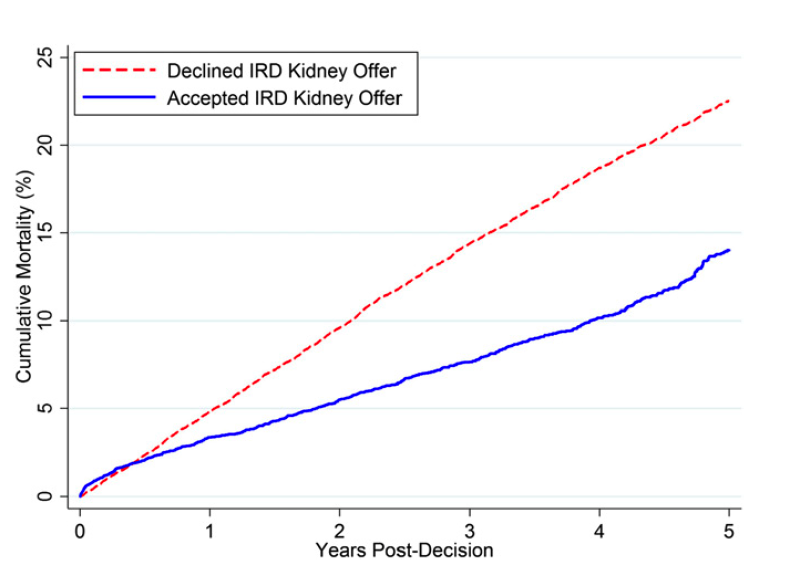
The United States Public Health Service (PHS) redefined donors who were previously classified by the Centers for Disease Control at increased risk for transmission of hepatitis B virus (HBV), hepatitis C virus (HCV), and HIV. The number of deceased donors that are part of this classification has increased dramatically because of the opioid epidemic, comprising over 20% of donor kidneys. Overall, overdose-death donors accounted for 1.1% of organ donors in 2000 and 13.4% in 2017. Importantly, transplantation candidates and providers should be well versed in the very low risk of disease transmission from these donors, all significantly ,1% even under the highest-risk circumstances (intravenous drug overdose, syringe-on-person). Unfortunately, “PHS increased-risk donor” (IRD) status is independently associated with a nearly 2.5-fold increased odds of turndown. An analysis by Bowring et al. used SRTR data from 104,998 kidney transplantation candidates who were offered IRD kidneys that were eventually accepted. The median KDPI of these kidneys was 30 (interquartile range, 16–49). Importantly, after 5 years, only 31.0% of candidates who declined IRDs received non-IRD DDKTs later; the median KDPI of these non-IRD kidneys was 52. Those who accepted an IRD had a substantially lower risk of death at 1 to 6 months after decision (aHR, 0.50; 95% CI, 0.67 to 0.90; P=0.006) and beyond 6 months after decision (aHR, 0.46; 95% CI, 0.52 to 0.58; P< 0.001). A single-center report of PHS-IRD kidney utilization reviewed offers made to 2423 kidney transplant candidates from June 2004 to May 2005; 1502 ultimately received a transplant with or without a PHS-IRD kidney. Acceptance of a PHS-IRD kidney offer was associated with lower risk of mortality (3.63% versus 11.6%; aHR, 0.467; P = 0.0008) and decreased risk of allograft loss compared with non– PHS-IRD recipients (P=0.007), with no transmission of HCV, HBV, or HIV.

Copyright © ABIM Exam World
Created On: 05/12/2020
Last Modified: 01/28/2021
A 45-year-old female is wait listed for kidney transplant. Her native kidney disease is IgA nephropathy. Her blood group is B and her CPRA is 90%. You are seeing her in the clinic as a part for kidney transplant work. As a part of documentation, you discuss with her about Public Health Service – Increased Risk Donors (PHS-IRD). You explain to her about PHS-IRD and if she would consent for it. Your rational for explaining this is a high wait time for blood group B in your allocation area especially in the setting of CPRA 90%. Which of the following statements regarding the PHS-IRD is TRUE ?
| A. As per the new guidelines there is no need to take an informed consent for PHS-IRD from the potential recipient. | |
|
|
B. PHS-IRD kidneys have a discard rate of 2.5-fold. |
| C. The kidney from PHS-IRD have an infection transmission risk anywhere between 10-15% depending on the type of infection. | |
| D. Recipient who received IRD kidneys have increased risk of death at 6 months compared to those who declined the offer. | |
| E. There is increased risk of allograft loss in recipients of PHS-IRD kidneys. |
|
|
Correct Answer. Option B. PHS-IRD kidneys have a discard rate of 2.5-fold.
Explanation.
The United States Public Health Service (PHS) redefined donors who were previously classified by the Centers for Disease Control at increased risk for transmission of hepatitis B virus (HBV), hepatitis C virus (HCV), and HIV. The number of deceased donors that are part of this classification has increased dramatically because of the opioid epidemic, comprising over 20% of donor kidneys. Overall, overdose-death donors accounted for 1.1% of organ donors in 2000 and 13.4% in 2017. Importantly, transplantation candidates and providers should be well versed in the very low risk of disease transmission from these donors, all significantly ,1% even under the highest-risk circumstances (intravenous drug overdose, syringe-on-person). Unfortunately, “PHS increased-risk donor” (IRD) status is independently associated with a nearly 2.5-fold increased odds of turndown. An analysis by Bowring et al. used SRTR data from 104,998 kidney transplantation candidates who were offered IRD kidneys that were eventually accepted. The median KDPI of these kidneys was 30 (interquartile range, 16–49). Importantly, after 5 years, only 31.0% of candidates who declined IRDs received non-IRD DDKTs later; the median KDPI of these non-IRD kidneys was 52. Those who accepted an IRD had a substantially lower risk of death at 1 to 6 months after decision (aHR, 0.50; 95% CI, 0.67 to 0.90; P=0.006) and beyond 6 months after decision (aHR, 0.46; 95% CI, 0.52 to 0.58; P< 0.001). A single-center report of PHS-IRD kidney utilization reviewed offers made to 2423 kidney transplant candidates from June 2004 to May 2005; 1502 ultimately received a transplant with or without a PHS-IRD kidney. Acceptance of a PHS-IRD kidney offer was associated with lower risk of mortality (3.63% versus 11.6%; aHR, 0.467; P = 0.0008) and decreased risk of allograft loss compared with non– PHS-IRD recipients (P=0.007), with no transmission of HCV, HBV, or HIV.

Copyright © ABIM Exam World
Created On: 05/12/2020
Last Modified: 01/28/2021
All the following drugs mentioned below cause hyperkalemia. All the drugs act by a specific mechanism to induce hyperkalemia. Only one drug acts by a different mechanism of action. Which is the drug which induces hyperkalemia via a different mechanism than others?
| A. Heparin. | |
| B. Low molecular weight heparin. | |
| C. Aminoglutethimide. | |
| D. Dabigatran. | |
|
|
E. Calcineurin inhibitors. |
|
|
Correct Answer. Option D. Calcineurin inhibitors.
Explanation.
Heparin, Low molecular weight heparin, Aminoglutethimide and Dabigatran all cause impaired adrenal hormone metabolism. These drugs cause potent inhibition of adrenal hormone synthesis leading to hyperkalemia.
The hyperkalemia seen with calcineurin inhibition is likely multifactorial and relates to inhibitory effects on Na+-K+-ATPase in collecting ducts and possibly to distal tubular acidosis. In addition, there is evidence that decreased numbers of mineralocorticoid receptors, which are detected in 75% of patients who are treated with cyclosporine, lead to hyperkalemia and metabolic acidosis as a result of aldosterone resistance. Recently, it was demonstrated that cyclosporine reduces paracellin-1 expression in thick ascending limb cells. The resulting decrease in magnesium transport likely contributes to the magnesium wasting and hypomagnesemia induced by cyclosporine, which is associated with chronic interstitial fibrosis, a faster rate of decline of kidney function, and increased rates of graft loss in renal transplant recipients with CNI nephrotoxicity. Finally, it was shown that cyclosporine indirectly opens ATP-sensitive K+ channels by inhibition of calcineurin, which could contribute to the CNI-associated hyperkalemia.
Copyright © ABIM Exam World
Created On: 05/18/2020
Last Modified: 01/28/2021
All the following drugs mentioned below cause hyperkalemia. All the drugs act by a specific mechanism to induce hyperkalemia. Only one drug acts by a different mechanism of action. Which is the drug which induces hyperkalemia via a different mechanism than others?
| A. Heparin. | |
| B. Low molecular weight heparin. | |
| C. Aminoglutethimide. | |
| D. Dabigatran. | |
|
|
E. Calcineurin inhibitors. |
|
|
Correct Answer. Option D. Calcineurin inhibitors.
Explanation.
Heparin, Low molecular weight heparin, Aminoglutethimide and Dabigatran all cause impaired adrenal hormone metabolism. These drugs cause potent inhibition of adrenal hormone synthesis leading to hyperkalemia.
The hyperkalemia seen with calcineurin inhibition is likely multifactorial and relates to inhibitory effects on Na+-K+-ATPase in collecting ducts and possibly to distal tubular acidosis. In addition, there is evidence that decreased numbers of mineralocorticoid receptors, which are detected in 75% of patients who are treated with cyclosporine, lead to hyperkalemia and metabolic acidosis as a result of aldosterone resistance. Recently, it was demonstrated that cyclosporine reduces paracellin-1 expression in thick ascending limb cells. The resulting decrease in magnesium transport likely contributes to the magnesium wasting and hypomagnesemia induced by cyclosporine, which is associated with chronic interstitial fibrosis, a faster rate of decline of kidney function, and increased rates of graft loss in renal transplant recipients with CNI nephrotoxicity. Finally, it was shown that cyclosporine indirectly opens ATP-sensitive K+ channels by inhibition of calcineurin, which could contribute to the CNI-associated hyperkalemia.
Copyright © ABIM Exam World
Created On: 05/18/2020
Last Modified: 01/28/2021
A 35 year-old Caucasian male presents with persistent swelling of both legs associated with dark colored urine for two months. He went to an emergency room 2 months ago for these complaints and was told that he has some protein and blood in the urine. He was treated with 3 days of levofloxacin. There is no other past medical history. No history of skin rash or joint swelling. On examination the blood pressure was 130/85 mm Hg and there was bilateral 1+ pedal edema. Rest of the physical examination was normal. Urine analysis showed 3+ proteinuria, 10-15 RBCs per high-power field, and occasional RBC cast. The BUN was 10 mg/dL, serum creatinine was 0.9 mg/dL. Antistreptolysin was negative, C3 level is decreased and C4 level is normal. Antinuclear antibodies, ANCA, hepatitis B and C serology were negative. 24-hour urine collection showed 2 g proteinuria and a kidney biopsy was performed. On light microscopy, kidney biopsy showed increase in the mesangial matrix and cellularity and glomerular basement membrane appeared irregularly thickened. Silver stain revealed duplication of glomerular basement membrane in multiple glomeruli. Immunofluorescence showed positive staining for C3, but negative for IgG, IgM and IgA. Electron microscopy revealed electron-dense deposits in the mesangium and sub-endothelial area.
What is the most likely diagnosis?
| A. Acute poststreptococcal glomerular nephritis | |
| B. Diffuse proliferative lupus nephritis | |
| C. Dense deposit disease | |
|
|
D. C3 glomerulopathy |
| E. |
|
|
Copyright © ABIM Exam World
Created On: 09/12/2017
Last Modified: 03/07/2021
A 35 year-old Caucasian male presents with persistent swelling of both legs associated with dark colored urine for two months. He went to an emergency room 2 months ago for these complaints and was told that he has some protein and blood in the urine. He was treated with 3 days of levofloxacin. There is no other past medical history. No history of skin rash or joint swelling. On examination the blood pressure was 130/85 mm Hg and there was bilateral 1+ pedal edema. Rest of the physical examination was normal. Urine analysis showed 3+ proteinuria, 10-15 RBCs per high-power field, and occasional RBC cast. The BUN was 10 mg/dL, serum creatinine was 0.9 mg/dL. Antistreptolysin was negative, C3 level is decreased and C4 level is normal. Antinuclear antibodies, ANCA, hepatitis B and C serology were negative. 24-hour urine collection showed 2 g proteinuria and a kidney biopsy was performed. On light microscopy, kidney biopsy showed increase in the mesangial matrix and cellularity and glomerular basement membrane appeared irregularly thickened. Silver stain revealed duplication of glomerular basement membrane in multiple glomeruli. Immunofluorescence showed positive staining for C3, but negative for IgG, IgM and IgA. Electron microscopy revealed electron-dense deposits in the mesangium and sub-endothelial area.
What is the most likely diagnosis?
| A. Acute poststreptococcal glomerular nephritis | |
| B. Diffuse proliferative lupus nephritis | |
| C. Dense deposit disease | |
|
|
D. C3 glomerulopathy |
| E. |
|
|
Copyright © ABIM Exam World
Created On: 09/12/2017
Last Modified: 03/07/2021
A 25 year-old male comes to the physician complaining of flank pain and hematuria. He says the pain is constant and dull. There is no frequency, urgency or dysuria. He has a history of mental retardation and seizures. On physical exam his blood pressure is 140/90 mm Hg, and his pulse is 80 bpm. He has multiple yellow papules across his nose and cheeks and numerous areas of blanched skin spots on his face. A 2-3 cm hypopigmented macule is noted on the right arm. CT scan of the head was done as patient presented with seizures. CT head was reported normal. CT scan of the abdomen shows bilateral hypodense fat containing renal masses and cysts.
What is the MOST likely diagnosis associated with these findings?
| A. Von Hippel Lindau | |
| B. Sturge Weber Syndrome | |
|
|
C. Tuberous Sclerosis |
| D. Osler Weber Rendu | |
| E. Neurofibromatosis type 2 |
|
|
Copyright © ABIM Exam World
Created On: 09/13/2017
Last Modified: 12/30/2017
A 25 year-old male comes to the physician complaining of flank pain and hematuria. He says the pain is constant and dull. There is no frequency, urgency or dysuria. He has a history of mental retardation and seizures. On physical exam his blood pressure is 140/90 mm Hg, and his pulse is 80 bpm. He has multiple yellow papules across his nose and cheeks and numerous areas of blanched skin spots on his face. A 2-3 cm hypopigmented macule is noted on the right arm. CT scan of the head was done as patient presented with seizures. CT head was reported normal. CT scan of the abdomen shows bilateral hypodense fat containing renal masses and cysts.
What is the MOST likely diagnosis associated with these findings?
| A. Von Hippel Lindau | |
| B. Sturge Weber Syndrome | |
|
|
C. Tuberous Sclerosis |
| D. Osler Weber Rendu | |
| E. Neurofibromatosis type 2 |
|
|
Copyright © ABIM Exam World
Created On: 09/13/2017
Last Modified: 12/30/2017
A 15 year-old boy is brought to the ER by his foster mother who states that when she got home from work she noticed he was acting very strange. He had slurred speech and seemed confused. He appeared to be very uncoordinated and she was not sure if he fell or hit his head. She states that he is somewhat a troubled boy but doesn’t know much about his history as he has been in and out of the foster care system out of state. On physical exam, he is tachycardic and has tachypnoea. Pupils are dilated, but there is no nystagmus. A fundoscopic exam shows hyperemia of the optic disk. He is relatively uncooperative but not aggressive or hostile. When asked about suicidal thoughts he responds only with inaudible mumbling. His foster mother left for work 10 hours prior and assumed he left for school. She is not sure when these symptoms began or what may have initiated them. P is 105/ min, BP is 140/90 mm Hg, RR is 28/min, and T is 97.1 F. Laboratory examination is as follows:
Na 135 mEq/L
K 5.0 mEq/L
CL 105 mEq/L
BUN 19 mg/dL
Cr 1.3 mg/dL
HCO3 8 mEq/L
Glucose 100 mg/dL
pH 7.3
pO2 90 mmHg
pCO2 22 mmHg
Measured serum osmolarity 320 mmol/L
What is the next step in management?
| A. Gastric lavage | |
| B. N-acetylcystiene and activated charcoal | |
| C. Fomepizole | |
|
|
D. Fomepizole and Hemodialysis |
| E. Obtain serum levels of salycylate, methanol and ethylene glycol levels |
|
|
Copyright © ABIM Exam World
Created On: 09/13/2017
Last Modified: 12/30/2017
A 15 year-old boy is brought to the ER by his foster mother who states that when she got home from work she noticed he was acting very strange. He had slurred speech and seemed confused. He appeared to be very uncoordinated and she was not sure if he fell or hit his head. She states that he is somewhat a troubled boy but doesn’t know much about his history as he has been in and out of the foster care system out of state. On physical exam, he is tachycardic and has tachypnoea. Pupils are dilated, but there is no nystagmus. A fundoscopic exam shows hyperemia of the optic disk. He is relatively uncooperative but not aggressive or hostile. When asked about suicidal thoughts he responds only with inaudible mumbling. His foster mother left for work 10 hours prior and assumed he left for school. She is not sure when these symptoms began or what may have initiated them. P is 105/ min, BP is 140/90 mm Hg, RR is 28/min, and T is 97.1 F. Laboratory examination is as follows:
Na 135 mEq/L
K 5.0 mEq/L
CL 105 mEq/L
BUN 19 mg/dL
Cr 1.3 mg/dL
HCO3 8 mEq/L
Glucose 100 mg/dL
pH 7.3
pO2 90 mmHg
pCO2 22 mmHg
Measured serum osmolarity 320 mmol/L
What is the next step in management?
| A. Gastric lavage | |
| B. N-acetylcystiene and activated charcoal | |
| C. Fomepizole | |
|
|
D. Fomepizole and Hemodialysis |
| E. Obtain serum levels of salycylate, methanol and ethylene glycol levels |
|
|
Copyright © ABIM Exam World
Created On: 09/13/2017
Last Modified: 12/30/2017
All of the following are helpful in predicting AV Graft stenosis EXCEPT:
| A. Hyperpulsatility of the AV Graft | |
| B. Ruduced pulse augmentation | |
| C. Increased bleeding and clots | |
| D. Decreased KT/V | |
| E. Decreased Blood Flow rate | |
|
|
F. Surveillance of the graft |
|
|
Copyright © ABIM Exam World
Created On: 09/14/2017
Last Modified: 08/06/2018
All of the following are helpful in predicting AV Graft stenosis EXCEPT:
| A. Hyperpulsatility of the AV Graft | |
| B. Ruduced pulse augmentation | |
| C. Increased bleeding and clots | |
| D. Decreased KT/V | |
| E. Decreased Blood Flow rate | |
|
|
F. Surveillance of the graft |
|
|
Copyright © ABIM Exam World
Created On: 09/14/2017
Last Modified: 08/06/2018
A 25 year-old female is referred by her primary care provider for evaluation of hypertension and hypokalemia. The primary care provider has already started her on oral potassium, despite therapy her Potassium being 2.8 meq/L. Her blood pressure despite treatment with amlodipine and Lisinopril 154/96 mm of Hg. There is no renal bruit. Systemic and fundus examinations are normal. Her mother was also diagnosed with hypertension at an early age. Her brother died of a cerebrovascular accident 2 years ago. Laboratory findings are as follows:
Na 140
Potassium 2.8
Chloride 100
HCO3 26
BUN 15
Creatinine 0.8
Glucose 110
TSH and Cortisol are normal
ACTH elevated
Renin 0.7 (Low)
Aldosterone 48 (elevated)
Urinalysis:
Sodium 240 mEq/D
Potassium 98 mEq/D
Urinary 18-OH Cortisol and 18-oxocortisol are elevated.
The most appropriate treatment for this patient is:
| A. Steroids | |
| B. Spironolactone | |
|
|
C. Steroids + Spironolactone |
| D. Amiloride |
|
|
Copyright © ABIM Exam World
Created On: 09/20/2017
Last Modified: 08/06/2018
A 25 year-old female is referred by her primary care provider for evaluation of hypertension and hypokalemia. The primary care provider has already started her on oral potassium, despite therapy her Potassium being 2.8 meq/L. Her blood pressure despite treatment with amlodipine and Lisinopril 154/96 mm of Hg. There is no renal bruit. Systemic and fundus examinations are normal. Her mother was also diagnosed with hypertension at an early age. Her brother died of a cerebrovascular accident 2 years ago. Laboratory findings are as follows:
Na 140
Potassium 2.8
Chloride 100
HCO3 26
BUN 15
Creatinine 0.8
Glucose 110
TSH and Cortisol are normal
ACTH elevated
Renin 0.7 (Low)
Aldosterone 48 (elevated)
Urinalysis:
Sodium 240 mEq/D
Potassium 98 mEq/D
Urinary 18-OH Cortisol and 18-oxocortisol are elevated.
The most appropriate treatment for this patient is:
| A. Steroids | |
| B. Spironolactone | |
|
|
C. Steroids + Spironolactone |
| D. Amiloride |
|
|
Copyright © ABIM Exam World
Created On: 09/20/2017
Last Modified: 08/06/2018
You are the nephrologist on call. The ER calls you for an 18 year-old female who complaining of vomiting and diarrhea. Her serum sodium is 116 mEq/L and Serum potassium is 5.9 mEq/L. On physical examination the patient is drowsy, Pulse is 126/min, BP is 90/60 mm of Hg, and RR is 32/min. Her chest is clear. Her heart sounds are normal, and no murmur is visible. The patient is drowsy but arousable and there was no focal neurological deficit. Laboratory findings are as follows:
Hb 16 gm/dl
WBC 12,800/cmm
Polymorph 46%
Lymphocytes 16%
Eosinophils 4%
Monocytes 4%
Platelets 2,40,000/cmm.
CL 70 mEq/L
BUN 10 mg/dl
Creatinine 0.5 mg/dl
Na 116 mEq/L
K 5.8 mEq/L
Urinalysis:
pH 6.4
Protein trace
Glucose absent
microscopic occasional WBCs & RBCs
Urinary Na 90 mEq/L
Urinary K 20 mEq/L
ABG
PH 7.32
PCO2 36
HCO3 20 mEq/L
PaO2 92
O2 saturation 98%
S. Cortisol 6.00 mg/dl
TSH 3.5 IU/m (Normal 0-5 IU/m ).
Both plasma Renin and Aldosterone are high.
Which of the following conditions is most likely with these findings?
| A. Type 4 RTA | |
|
|
B. Pseudo-hypo-aldosteronism Type 1 |
| C. Gordon's syndrome | |
| D. Diarrhea |
|
|
Copyright © ABIM Exam World
Created On: 09/20/2017
Last Modified: 08/06/2018
You are the nephrologist on call. The ER calls you for an 18 year-old female who complaining of vomiting and diarrhea. Her serum sodium is 116 mEq/L and Serum potassium is 5.9 mEq/L. On physical examination the patient is drowsy, Pulse is 126/min, BP is 90/60 mm of Hg, and RR is 32/min. Her chest is clear. Her heart sounds are normal, and no murmur is visible. The patient is drowsy but arousable and there was no focal neurological deficit. Laboratory findings are as follows:
Hb 16 gm/dl
WBC 12,800/cmm
Polymorph 46%
Lymphocytes 16%
Eosinophils 4%
Monocytes 4%
Platelets 2,40,000/cmm.
CL 70 mEq/L
BUN 10 mg/dl
Creatinine 0.5 mg/dl
Na 116 mEq/L
K 5.8 mEq/L
Urinalysis:
pH 6.4
Protein trace
Glucose absent
microscopic occasional WBCs & RBCs
Urinary Na 90 mEq/L
Urinary K 20 mEq/L
ABG
PH 7.32
PCO2 36
HCO3 20 mEq/L
PaO2 92
O2 saturation 98%
S. Cortisol 6.00 mg/dl
TSH 3.5 IU/m (Normal 0-5 IU/m ).
Both plasma Renin and Aldosterone are high.
Which of the following conditions is most likely with these findings?
| A. Type 4 RTA | |
|
|
B. Pseudo-hypo-aldosteronism Type 1 |
| C. Gordon's syndrome | |
| D. Diarrhea |
|
|
Copyright © ABIM Exam World
Created On: 09/20/2017
Last Modified: 08/06/2018
A 36 year-old female was diagnosed as having membranous nephropathy secondary to SLE. Her 24 hour protein excretion was 7.5 gms/day. Her serum creatinine was 0.9mg/dl. She was started on 500 mg of cyclophosphamide IV every 15 days (Euro-Lupus) and prednisolone 1 mg/kg orally per day. After 3 months of therapy, she presented with decreased urine output, puffiness of face, and oedema feet. On physical examination, her temperature is 37 C, blood pressure is 160/100 mm Hg, pulse is 90/min, and respiration rate is 20/min. She is anemic and there is puffiness of the face and oedema of the feet. On systemic examination air entry was decreased in the bases of both the lung fields and heart sounds are distant and feeble. Chest X-Ray reveals bilateral pleural effusions. Echocardiogram reveals mild to moderate pericardial effusion. Laboratory examination is as follows:
Hemoglobin 10.0 g/dL
Hematocrit 34%
Platelet Count 150,000 mm3
WBC 8,000 mm3
Differential count P 80% L 12% E 6% M 2%
ESR 50.8 mm/h
Urinalysis:
Protein 1450 mg/24 h
Glucose None
RBCs 70-80/HPF dysmorphic
WBCs 5-8/HPF
Leukocyte Esterase Negative
Nitrites Negative
BUN 35 mg/dL
Creatinine 3.9 mg/dL
Sodium 140 mEq/L
Potassium 5.2 mEq/L
Bicarbonate 15.5 mEq/L
Calcium 9.2 mEq/L
Phosphorus 5.6 mg/dL
Glucose 100 mg/dL
Uric Acid 5.3 mg/dL
C3 & C4 decreased
ANA positive
dsDNA positive
Repeat biopsy shows:

Which of the following is the most appropriate therapy for her current condition?
| A. Mycophenolate and steroid | |
|
|
B. Mycophenolate, tacrolimus and steroids |
| C. Rituximab | |
| D. I.V Immunoglobulins | |
| E. Plasma exchange |
|
|
Copyright © ABIM Exam World
Created On: 09/20/2017
Last Modified: 08/06/2018
A 36 year-old female was diagnosed as having membranous nephropathy secondary to SLE. Her 24 hour protein excretion was 7.5 gms/day. Her serum creatinine was 0.9mg/dl. She was started on 500 mg of cyclophosphamide IV every 15 days (Euro-Lupus) and prednisolone 1 mg/kg orally per day. After 3 months of therapy, she presented with decreased urine output, puffiness of face, and oedema feet. On physical examination, her temperature is 37 C, blood pressure is 160/100 mm Hg, pulse is 90/min, and respiration rate is 20/min. She is anemic and there is puffiness of the face and oedema of the feet. On systemic examination air entry was decreased in the bases of both the lung fields and heart sounds are distant and feeble. Chest X-Ray reveals bilateral pleural effusions. Echocardiogram reveals mild to moderate pericardial effusion. Laboratory examination is as follows:
Hemoglobin 10.0 g/dL
Hematocrit 34%
Platelet Count 150,000 mm3
WBC 8,000 mm3
Differential count P 80% L 12% E 6% M 2%
ESR 50.8 mm/h
Urinalysis:
Protein 1450 mg/24 h
Glucose None
RBCs 70-80/HPF dysmorphic
WBCs 5-8/HPF
Leukocyte Esterase Negative
Nitrites Negative
BUN 35 mg/dL
Creatinine 3.9 mg/dL
Sodium 140 mEq/L
Potassium 5.2 mEq/L
Bicarbonate 15.5 mEq/L
Calcium 9.2 mEq/L
Phosphorus 5.6 mg/dL
Glucose 100 mg/dL
Uric Acid 5.3 mg/dL
C3 & C4 decreased
ANA positive
dsDNA positive
Repeat biopsy shows:

Which of the following is the most appropriate therapy for her current condition?
| A. Mycophenolate and steroid | |
|
|
B. Mycophenolate, tacrolimus and steroids |
| C. Rituximab | |
| D. I.V Immunoglobulins | |
| E. Plasma exchange |
|
|
Copyright © ABIM Exam World
Created On: 09/20/2017
Last Modified: 08/06/2018
You are rounding on your patients in the dialysis unit and seeing a 65-year-old gentleman with ESRD due to chronic interstitial disease. He also has a history of diet-controlled diabetes mellitus and hypertension. His other past medical history is significant for dyslipidemia, coronary artery disease, hypothyroidism, gout and depression. He has been hospitalized in the recent past for swelling and pain of his right great toe. He was seen by the foot doctor, a scan was done and eventually the great toe had to be amputated. He has been on hemodialysis 3 times a week. His weekly Kt/V is 1.9. You are conducting the monthly blood work review for this patient. You note that his hemoglobin has been persistently low for past few monthly blood draws. He is currently on 100 mcg of Darbepoetin weekly on dialysis. On enquiry there is no history of blood loss in the form of hematemesis, melena, hematochezia or hemoptysis. His active medication list includes Losartan, Atorvastatin, Calcitriol, multivitamin supplements, paroxetine, allopurinol, aspirin.
His pertinent blood work is as follows:
Test | Result |
WBC | 4500 cells /cumm |
Hemoglobin | 8.2 g/dL |
Platelet count | 450 thousand /cumm |
Reticulocyte count | Normal |
Iron | 55 (range 50-150) |
Total iron binding capacity | 250 g/dl (range 250-310) |
Transferrin saturation | 20% |
Ferritin | 1400 ng/ml (range 20-235) |
Haptoglobin | 400 mg/dl (range 83-267) |
Lactate dehydrogenase | 240 U/L (range 80-225) |
Total bilirubin | 1.0 mg/dl |
Folate | 7 ng/ml (range 1.8-9.0) |
B12 | 500 pg/ml (range 200-800) |
Peripheral blood smear. | Normal RBC morphology, few burr cells. |
Which of the following is true about this patient’s anemia?
Omitted
|
Correct Answer: Option C: This patient has chronically inflamed state which is contributing to his anemia.
Explanation:
10-15% of patients who have been receiving erythrocyte estimating agents (ESA) develop resistance. There are multiple reasons why ESRD patients develop resistance.
ESA resistance occurs due to the following reasons:
Iron deficiency.
Chronic inflammation.
Under-dialysis.
Hemolysis.
Folate and B12 deficiency.
Chronic blood loss.
Anti EPO antibodies.
Pure red cell aplasia.
Failed chronic renal allograft.
ACEI/ARB.
Aluminum overload.
Hyperparathyroidism.
Hematological disorders or malignancy.
Option A: Incorrect option. ESRD is associated with erythropoietin deficiency. Patient has been initiated on ESA already. There is no point in measuring EPO levels. There is no evidence of measuring EPO levels in management of anemia in CKD.
Option B: Incorrect option. ESRD is an inflamed state. In inflammatory milieu there is increased production of Hepcidin. The hepatic iron-regulatory hormone Hepcidin and its receptor, the cellular iron exporter Ferroportin, constitute a feedback-regulated mechanism that maintains adequate plasma concentrations of iron-transferrin for erythropoiesis and other functions, ensures sufficient iron stores, and avoids iron toxicity. In chronic kidney disease, inflammation and impaired renal clearance increases plasma hepcidin, inhibiting duodenal iron absorption and sequestering iron in macrophages. These effects of hepcidin can cause systemic iron deficiency, decreased availability of iron for erythropoiesis, and resistance to endogenous and exogenous erythropoietin.
Choice C: Correct option. Refer explanation for option B. He had pain, swelling of his right great toe, a foot doctor sees him, a bone scan is done and subsequently the amputation. All suggestive of an infective etiology probably osteomyelitis.There is a temporal relationship between patients’ anemia and underlying chronic inflammatory state.
The high ferritin is also suggestive of inflamed state.
Choice D: Incorrect option. Pure red cell aplasia, a form of severe ESA hypo-responsiveness mediated by anti-erythropoietin antibodies, was first reported with certain formulations of Epoetin alfa but has now been reported with all commercially available forms of ESA. This syndrome presents with rapid onset of severe anemia (hemoglobin <7 g/dl), severe reticulocytopenia (reticulocyte count <10,000/?l) and marked elevations in serum ferritin level (>1000 ng/ml) and transferrin saturation (>70%) resulting from low iron utilization. Pure red cell aplasia is unlikely given the absence of characteristic laboratory findings. Moreover, the patient did not receive Epoetin alfa.
Choice E: Incorrect option. Under-dialysis leads to anemia due the same mechanism mentioned earlier in option B. Under-dialysis worsens the uremic milieu which in turn leads to inflammatory state. This leads to anemia. Patient in this clinical vignette has been dialysed appropriately. His weekly Kt/V is 1.9, which is above the target goal of 1.7
Copyright © ABIM Exam World
Created On: 10/22/2018
Last Modified: 04/17/2021
You are rounding on your patients in the dialysis unit and seeing a 65-year-old gentleman with ESRD due to chronic interstitial disease. He also has a history of diet-controlled diabetes mellitus and hypertension. His other past medical history is significant for dyslipidemia, coronary artery disease, hypothyroidism, gout and depression. He has been hospitalized in the recent past for swelling and pain of his right great toe. He was seen by the foot doctor, a scan was done and eventually the great toe had to be amputated. He has been on hemodialysis 3 times a week. His weekly Kt/V is 1.9. You are conducting the monthly blood work review for this patient. You note that his hemoglobin has been persistently low for past few monthly blood draws. He is currently on 100 mcg of Darbepoetin weekly on dialysis. On enquiry there is no history of blood loss in the form of hematemesis, melena, hematochezia or hemoptysis. His active medication list includes Losartan, Atorvastatin, Calcitriol, multivitamin supplements, paroxetine, allopurinol, aspirin.
His pertinent blood work is as follows:
Test | Result |
WBC | 4500 cells /cumm |
Hemoglobin | 8.2 g/dL |
Platelet count | 450 thousand /cumm |
Reticulocyte count | Normal |
Iron | 55 (range 50-150) |
Total iron binding capacity | 250 g/dl (range 250-310) |
Transferrin saturation | 20% |
Ferritin | 1400 ng/ml (range 20-235) |
Haptoglobin | 400 mg/dl (range 83-267) |
Lactate dehydrogenase | 240 U/L (range 80-225) |
Total bilirubin | 1.0 mg/dl |
Folate | 7 ng/ml (range 1.8-9.0) |
B12 | 500 pg/ml (range 200-800) |
Peripheral blood smear. | Normal RBC morphology, few burr cells. |
Which of the following is true about this patient’s anemia?
Omitted
|
Correct Answer: Option C: This patient has chronically inflamed state which is contributing to his anemia.
Explanation:
10-15% of patients who have been receiving erythrocyte estimating agents (ESA) develop resistance. There are multiple reasons why ESRD patients develop resistance.
ESA resistance occurs due to the following reasons:
Iron deficiency.
Chronic inflammation.
Under-dialysis.
Hemolysis.
Folate and B12 deficiency.
Chronic blood loss.
Anti EPO antibodies.
Pure red cell aplasia.
Failed chronic renal allograft.
ACEI/ARB.
Aluminum overload.
Hyperparathyroidism.
Hematological disorders or malignancy.
Option A: Incorrect option. ESRD is associated with erythropoietin deficiency. Patient has been initiated on ESA already. There is no point in measuring EPO levels. There is no evidence of measuring EPO levels in management of anemia in CKD.
Option B: Incorrect option. ESRD is an inflamed state. In inflammatory milieu there is increased production of Hepcidin. The hepatic iron-regulatory hormone Hepcidin and its receptor, the cellular iron exporter Ferroportin, constitute a feedback-regulated mechanism that maintains adequate plasma concentrations of iron-transferrin for erythropoiesis and other functions, ensures sufficient iron stores, and avoids iron toxicity. In chronic kidney disease, inflammation and impaired renal clearance increases plasma hepcidin, inhibiting duodenal iron absorption and sequestering iron in macrophages. These effects of hepcidin can cause systemic iron deficiency, decreased availability of iron for erythropoiesis, and resistance to endogenous and exogenous erythropoietin.
Choice C: Correct option. Refer explanation for option B. He had pain, swelling of his right great toe, a foot doctor sees him, a bone scan is done and subsequently the amputation. All suggestive of an infective etiology probably osteomyelitis.There is a temporal relationship between patients’ anemia and underlying chronic inflammatory state.
The high ferritin is also suggestive of inflamed state.
Choice D: Incorrect option. Pure red cell aplasia, a form of severe ESA hypo-responsiveness mediated by anti-erythropoietin antibodies, was first reported with certain formulations of Epoetin alfa but has now been reported with all commercially available forms of ESA. This syndrome presents with rapid onset of severe anemia (hemoglobin <7 g/dl), severe reticulocytopenia (reticulocyte count <10,000/?l) and marked elevations in serum ferritin level (>1000 ng/ml) and transferrin saturation (>70%) resulting from low iron utilization. Pure red cell aplasia is unlikely given the absence of characteristic laboratory findings. Moreover, the patient did not receive Epoetin alfa.
Choice E: Incorrect option. Under-dialysis leads to anemia due the same mechanism mentioned earlier in option B. Under-dialysis worsens the uremic milieu which in turn leads to inflammatory state. This leads to anemia. Patient in this clinical vignette has been dialysed appropriately. His weekly Kt/V is 1.9, which is above the target goal of 1.7
Copyright © ABIM Exam World
Created On: 10/22/2018
Last Modified: 04/17/2021
50-year-old female patient whos group B is being evaluated for kidney transplant surgery. She had ESRD secondary to analgesic nephropathy and is on hemodialysis for last 5 years. She has had multiple sensitization events in the form of 3 pregnancies and several blood transfusions. Her current calculated PRA against class I antigen is 97% and against class II antigen is 99%. She has been enrolled in the national highly sensitized recipient program.
Her husband who is blood group matched came forward as a potential kidney donor but she had positive Flow B and T Cell Cross match against him. Single antigen bead assay demonstrated that she has donor specific antibodies against class II across DQB*15 and DPB*14. This transplant did not materialize as patient declined desensitization protocol. Now her younger brother comes forward as a potential donor. He is blood group A and the flow B and T cell cross match is negative with no demonstrable donor specific antibodies against this donor.Patient wants to know more about ABO incompatible transplant.
Which of the following statements about the ABO incompatible transplant is correct?
| A. Three-year graft survival is inferior to blood group compatible transplants. | |
| B. The infectious and bleeding complications post ABOI kidney transplant are the same as blood matched kidney transplant. | |
| C. All patients undergoing ABOI transplant need to undergo desensitization using IVIg, Plasma exchange, Rituximab irrespective of their donor/recipient pair Anti ABO titers for optimal outcomes. | |
|
|
D. C4d staining on protocol biopsies is common feature and does not necessarily mean an antibody mediated rejection process in the absence of allograft dysfunction. |
|
|
Correct answer: Option D: C4d staining on protocol biopsies is common feature and does not necessarily mean an antibody mediated rejection process.
Explanation:
Choice A: Three-year graft survival is inferior to blood group compatible transplants is incorrect A comprehensive database analysis of 1420 ABOI living donor (LD) kidney transplants performed in 101 centers from 2005 to 2012 compared graft and patient survival to a matched cohort of ABO-compatible transplant recipients. Three-year graft and patient survival were ultimately identical. 1
Choice B: The infectious and bleeding complications post ABOI kidney transplant as same as blood matched kidney transplant is also incorrect. Using USRDS and Medicare data from 2000–2007, 119 ABOI (non-A2 donor) transplant recipients were identified. Compared with ABO-compatible recipients, the risks of infectious and hemorrhagic complications were significantly higher, with a 2.2-fold higher risk of pneumonia, a 3.5-fold higher risk of wound infections, a 56% higher risk of pyelonephritis, and a nearly 2- fold higher risk of hemorrhage 2
Choice C: All patients undergoing ABOI transplant need to undergo desensitization using IVIg, Plasma exchange, Rituximab irrespective of their donor/recipient pair Anti ABO titers for optimal outcomes is also an incorrect answer. Historically, ABOI transplantation has been successful when performed after desensitization with plasmapheresis, intravenous Ig (IVIG), rituximab, and/or splenectomy to achieve ABO IgG antibody titers 1:4. A recent publication demonstrated that these intensified treatments might not be necessary in donor/recipient pairs who have low-moderate titer ABO incompatibility 3
Choice D: C4d staining on protocol biopsies is common feature and does not necessarily mean an antibody mediated rejection process in the absence of allograft dysfunction is the correct answer C4d staining is not an uncommon feature seen in the protocol biopsies done in ABOI kidney transplant recipients. In the absence of allograft dysfunction, the C4d staining has no clinical relevance and is just a part of the graft accommodation.
Copyright © ABIM Exam World
Created On: 10/30/2018
Last Modified: 10/23/2020
50-year-old female patient whos group B is being evaluated for kidney transplant surgery. She had ESRD secondary to analgesic nephropathy and is on hemodialysis for last 5 years. She has had multiple sensitization events in the form of 3 pregnancies and several blood transfusions. Her current calculated PRA against class I antigen is 97% and against class II antigen is 99%. She has been enrolled in the national highly sensitized recipient program.
Her husband who is blood group matched came forward as a potential kidney donor but she had positive Flow B and T Cell Cross match against him. Single antigen bead assay demonstrated that she has donor specific antibodies against class II across DQB*15 and DPB*14. This transplant did not materialize as patient declined desensitization protocol. Now her younger brother comes forward as a potential donor. He is blood group A and the flow B and T cell cross match is negative with no demonstrable donor specific antibodies against this donor.Patient wants to know more about ABO incompatible transplant.
Which of the following statements about the ABO incompatible transplant is correct?
| A. Three-year graft survival is inferior to blood group compatible transplants. | |
| B. The infectious and bleeding complications post ABOI kidney transplant are the same as blood matched kidney transplant. | |
| C. All patients undergoing ABOI transplant need to undergo desensitization using IVIg, Plasma exchange, Rituximab irrespective of their donor/recipient pair Anti ABO titers for optimal outcomes. | |
|
|
D. C4d staining on protocol biopsies is common feature and does not necessarily mean an antibody mediated rejection process in the absence of allograft dysfunction. |
|
|
Correct answer: Option D: C4d staining on protocol biopsies is common feature and does not necessarily mean an antibody mediated rejection process.
Explanation:
Choice A: Three-year graft survival is inferior to blood group compatible transplants is incorrect A comprehensive database analysis of 1420 ABOI living donor (LD) kidney transplants performed in 101 centers from 2005 to 2012 compared graft and patient survival to a matched cohort of ABO-compatible transplant recipients. Three-year graft and patient survival were ultimately identical. 1
Choice B: The infectious and bleeding complications post ABOI kidney transplant as same as blood matched kidney transplant is also incorrect. Using USRDS and Medicare data from 2000–2007, 119 ABOI (non-A2 donor) transplant recipients were identified. Compared with ABO-compatible recipients, the risks of infectious and hemorrhagic complications were significantly higher, with a 2.2-fold higher risk of pneumonia, a 3.5-fold higher risk of wound infections, a 56% higher risk of pyelonephritis, and a nearly 2- fold higher risk of hemorrhage 2
Choice C: All patients undergoing ABOI transplant need to undergo desensitization using IVIg, Plasma exchange, Rituximab irrespective of their donor/recipient pair Anti ABO titers for optimal outcomes is also an incorrect answer. Historically, ABOI transplantation has been successful when performed after desensitization with plasmapheresis, intravenous Ig (IVIG), rituximab, and/or splenectomy to achieve ABO IgG antibody titers 1:4. A recent publication demonstrated that these intensified treatments might not be necessary in donor/recipient pairs who have low-moderate titer ABO incompatibility 3
Choice D: C4d staining on protocol biopsies is common feature and does not necessarily mean an antibody mediated rejection process in the absence of allograft dysfunction is the correct answer C4d staining is not an uncommon feature seen in the protocol biopsies done in ABOI kidney transplant recipients. In the absence of allograft dysfunction, the C4d staining has no clinical relevance and is just a part of the graft accommodation.
Copyright © ABIM Exam World
Created On: 10/30/2018
Last Modified: 10/23/2020
A 19-year-old woman, African American descent, comes to clinic for follow up visit. She has been found to have type 1 diabetes mellitus since the age of 12 years of age. She has been using insulin pump for the last 5 years. She reports no hypoglycemic symptoms and has been monitoring blood sugar using flash glucose monitor. She reports infrequent hypoglycemic episodes all being self-managed. She met with an ophthalmologist for eye screening and has no retinopathy. She exercises regularly for 30 mins. Her vitals recording shows BP of 127/66 mmHg. Her BMI is 22.2. Systemic examination is unremarkable.
Her laboratory investigation is as follows.
Characteristic | value |
Hemoglobin | 13.2 gm/L |
WBC count | 7.8 X 10³/cubic mm |
Platelet count | 241 X 103/cubic mm |
Segmented Neutrophils Lymphocytes Monocytes Band neutrophils Eosinophils Basophils | 60% 36% 2% 0% 2% 0% |
Sr. Sodium | 136 mEq/L |
Sr. Potassium | 4.2 mEq/L |
Sr. Creatinine | 0.6 mg/dL |
eGFR using CKD-EPI | 153.1 ml/min/1.73m2 |
Sr. Bicarbonate | 24 mEq/L |
Sr. Chloride | 101 mEq/L |
Total Bilirubin | 1.0 mg /dL |
AST | 16 U/L |
ALT | 18 U/L |
Sr. Albumin | 4.0 g/dL |
HBA1C | 8.2% |
Sr. Calcium | 10 mg/dL |
Urine dipstick | pH- 5.4 Albumin-nil no blood no WBCs |
24-hour urinary protein | 86 milligrams/day |
What is the MOST LIKELY False statement regarding renal hyper filtration stage of Diabetic Kidney Disease in this patient?
| A. Renal hyper filtration is attenuated by SGLT2 inhibition. | |
| B. Renal hyper filtration occurs in both type 1 and type 2 diabetes mellitus. | |
| C. Obesity can also lead to single-nephron hyper filtration. | |
|
|
D. Incretins like GLP-1 and GIP are neutral in terms of altering renal hemodynamics unlike SGLT2 blockers. |
|
|
The Correct Answer is Option D : Incretins like GLP-1 and GIP are neutral in terms of altering renal hemodynamics unlike SGLT2 blockers.
Supra-physiologic elevation in GFR is observed early in the natural history of type 1 and type 2 diabetes mellitus which is due to glomerular hyperfiltration. Pathogenesis of hyper filtration in diabetes is complex with a prominent role for hyperglycemia and distorted insulin levels especially in early diabetes and pre-diabetes.Dilatation of the afferent (pre-capillary) glomerular arteriole plays an important role in the hyper-filtration response, by raising both the intra-glomerular pressure and renal blood flow.
The effect of incretins can be demonstrated by experiment using GLP-1 receptor agonists (GLP-1RA) and dipeptidyl peptidase (DPP)–4 inhibitors which are associated with renal hemodynamic effects, potentially beyond glycemic control. These observations have been attributed to a GLP-1–mediated inhibition of NHE3 (which assembles with DPP-4 in the proximal tubular brush border), thereby reducing proximal sodium reabsorption and GFR through activation of TGF (tubuloglomerular feedback).
Option A : In an 8-week study, empagliflozin in T1DM patients with whole-kidney hyper filtration (mean GFR 172±23 ml/min per 1.73 m2) demonstrated a glucose-independent 19%decrease in GFR, which was associated with a decline in ERPF (estimated renal plasma flow) and estimated glomerular pressure and increase in afferent arteriolar resistance, as assessed by the Gomez equations. SGLT2 inhibition could reduce (single-nephron) hyperfiltration in diabetes by restoring sodium-chloride concentration at the macula densa and subsequent TGF mediated afferent arteriolar vasoconstriction.
Option B : Reported prevalence of hyper filtration at the whole-kidney level vary greatly: between 10% and 67% in type 1 diabetes mellitus (T1DM) (with GFR values up to 162 ml/min per 1.73 m2), and 6%–73% in patients with type 2 diabetes (T2DM) (up to 166 ml/min per 1.73 sq. m.
Option C: Independent of diabetes and glucose levels, body weight also augments GFR (by about 15% in obese to about 56% in severely obese non-diabetic subjects).
Copyright © ABIM Exam World
Created On: 10/31/2018
Last Modified: 10/23/2020
A 19-year-old woman, African American descent, comes to clinic for follow up visit. She has been found to have type 1 diabetes mellitus since the age of 12 years of age. She has been using insulin pump for the last 5 years. She reports no hypoglycemic symptoms and has been monitoring blood sugar using flash glucose monitor. She reports infrequent hypoglycemic episodes all being self-managed. She met with an ophthalmologist for eye screening and has no retinopathy. She exercises regularly for 30 mins. Her vitals recording shows BP of 127/66 mmHg. Her BMI is 22.2. Systemic examination is unremarkable.
Her laboratory investigation is as follows.
Characteristic | value |
Hemoglobin | 13.2 gm/L |
WBC count | 7.8 X 10³/cubic mm |
Platelet count | 241 X 103/cubic mm |
Segmented Neutrophils Lymphocytes Monocytes Band neutrophils Eosinophils Basophils | 60% 36% 2% 0% 2% 0% |
Sr. Sodium | 136 mEq/L |
Sr. Potassium | 4.2 mEq/L |
Sr. Creatinine | 0.6 mg/dL |
eGFR using CKD-EPI | 153.1 ml/min/1.73m2 |
Sr. Bicarbonate | 24 mEq/L |
Sr. Chloride | 101 mEq/L |
Total Bilirubin | 1.0 mg /dL |
AST | 16 U/L |
ALT | 18 U/L |
Sr. Albumin | 4.0 g/dL |
HBA1C | 8.2% |
Sr. Calcium | 10 mg/dL |
Urine dipstick | pH- 5.4 Albumin-nil no blood no WBCs |
24-hour urinary protein | 86 milligrams/day |
What is the MOST LIKELY False statement regarding renal hyper filtration stage of Diabetic Kidney Disease in this patient?
| A. Renal hyper filtration is attenuated by SGLT2 inhibition. | |
| B. Renal hyper filtration occurs in both type 1 and type 2 diabetes mellitus. | |
| C. Obesity can also lead to single-nephron hyper filtration. | |
|
|
D. Incretins like GLP-1 and GIP are neutral in terms of altering renal hemodynamics unlike SGLT2 blockers. |
|
|
The Correct Answer is Option D : Incretins like GLP-1 and GIP are neutral in terms of altering renal hemodynamics unlike SGLT2 blockers.
Supra-physiologic elevation in GFR is observed early in the natural history of type 1 and type 2 diabetes mellitus which is due to glomerular hyperfiltration. Pathogenesis of hyper filtration in diabetes is complex with a prominent role for hyperglycemia and distorted insulin levels especially in early diabetes and pre-diabetes.Dilatation of the afferent (pre-capillary) glomerular arteriole plays an important role in the hyper-filtration response, by raising both the intra-glomerular pressure and renal blood flow.
The effect of incretins can be demonstrated by experiment using GLP-1 receptor agonists (GLP-1RA) and dipeptidyl peptidase (DPP)–4 inhibitors which are associated with renal hemodynamic effects, potentially beyond glycemic control. These observations have been attributed to a GLP-1–mediated inhibition of NHE3 (which assembles with DPP-4 in the proximal tubular brush border), thereby reducing proximal sodium reabsorption and GFR through activation of TGF (tubuloglomerular feedback).
Option A : In an 8-week study, empagliflozin in T1DM patients with whole-kidney hyper filtration (mean GFR 172±23 ml/min per 1.73 m2) demonstrated a glucose-independent 19%decrease in GFR, which was associated with a decline in ERPF (estimated renal plasma flow) and estimated glomerular pressure and increase in afferent arteriolar resistance, as assessed by the Gomez equations. SGLT2 inhibition could reduce (single-nephron) hyperfiltration in diabetes by restoring sodium-chloride concentration at the macula densa and subsequent TGF mediated afferent arteriolar vasoconstriction.
Option B : Reported prevalence of hyper filtration at the whole-kidney level vary greatly: between 10% and 67% in type 1 diabetes mellitus (T1DM) (with GFR values up to 162 ml/min per 1.73 m2), and 6%–73% in patients with type 2 diabetes (T2DM) (up to 166 ml/min per 1.73 sq. m.
Option C: Independent of diabetes and glucose levels, body weight also augments GFR (by about 15% in obese to about 56% in severely obese non-diabetic subjects).
Copyright © ABIM Exam World
Created On: 10/31/2018
Last Modified: 10/23/2020
A 30-year-old man was on hemodialysis for 6 months. The was an IV drug user and was diagnosed to have HIV. His elder sister comes forward as protentional kidney donor for him. He underwent a successful kidney transplant. Which of the following statements is true regarding kidney transplantation in HIV positive individuals and acute rejection episodes?
|
|
A. The episodes of acute rejection are more in HIV positive individuals compared to non-HIV positive patients. |
| B. The episodes of acute rejection are same in HIV positive individuals when compared to age and disease matched non-HIV counterparts. | |
| C. Cyclosporine is a preferred CNI as it has some invitro antiviral properties. | |
| D. There is a documented interaction between CNI and integrase inhibitors. Integrase inhibitors increase the CNI level. | |
| E. There is a proven benefit of using rATG for induction immunosuppression over anti IL-2 therapy to prevent rejections. |
|
|
Correct Answer. Option A. The episodes of acute rejection are more in HIV positive individuals compared to non-HIV positive patients.
Explanation.
Kidney transplant recipients with HIV have a high frequency of rejection. In a large, multicenter trial, one- and three-year rejection rates were 31 and 41 %, respectively, compared with an expected one-year rejection rate of 12 percent, as reported by SRTR for all kidney transplant recipients. At European transplant centers, where most patients are induced with interleukin (IL)-2 receptor antibodies, one-year, acute rejection rates among recipients with HIV have ranged from 15 to 44 %.
The higher rate of rejection in recipients with HIV is likely multifactorial. Drug-drug interactions between calcineurin inhibitors (CNIs) and protease inhibitors (PIs) can lead to subtherapeutic exposure to immunosuppressive agents. Patients on a CNI and PI require nonstandard dosing schedules (i.e. every other or every third day), which can make patient adherence difficult. Furthermore, concomitant administration of a PI and CNI results in a 40 % lower area under the curve (AUC) for CNI exposure at the same CNI target level, leading clinicians to systematically underdose patients taking both medications. Many transplant physicians seek to transition patients off PI-based regimens whenever possible in favor of integrase inhibitor-based regimens, which avoid these drug-drug interactions and permit standard immunosuppression dosing.
HIV-infected transplant recipients, compared with HIV-negative recipients, have a higher risk of acute rejection and, therefore, would theoretically benefit from antibody induction therapy. However, given the underlying immunosuppressed state of HIV-infected patients, prolonged lymphocyte depletion with antibody induction therapy could potentially increase their risk of developing opportunistic infections. Some centers avoid the use of antibody induction therapy among HIV-infected transplant recipients. In centers that use antibody induction therapy, some use basiliximab (an IL-2 receptor antibody) based upon data from two studies of HIV-infected kidney transplant recipients that demonstrated an increased risk of infection among those treated with rATG-Thymoglobulin. Other centers prefer to use rATG-Thymoglobulin given its superior efficacy in preventing acute rejection in HIV-negative recipients.
Copyright © ABIM Exam World
Created On: 05/12/2020
Last Modified: 01/28/2021
A 30-year-old man was on hemodialysis for 6 months. The was an IV drug user and was diagnosed to have HIV. His elder sister comes forward as protentional kidney donor for him. He underwent a successful kidney transplant. Which of the following statements is true regarding kidney transplantation in HIV positive individuals and acute rejection episodes?
|
|
A. The episodes of acute rejection are more in HIV positive individuals compared to non-HIV positive patients. |
| B. The episodes of acute rejection are same in HIV positive individuals when compared to age and disease matched non-HIV counterparts. | |
| C. Cyclosporine is a preferred CNI as it has some invitro antiviral properties. | |
| D. There is a documented interaction between CNI and integrase inhibitors. Integrase inhibitors increase the CNI level. | |
| E. There is a proven benefit of using rATG for induction immunosuppression over anti IL-2 therapy to prevent rejections. |
|
|
Correct Answer. Option A. The episodes of acute rejection are more in HIV positive individuals compared to non-HIV positive patients.
Explanation.
Kidney transplant recipients with HIV have a high frequency of rejection. In a large, multicenter trial, one- and three-year rejection rates were 31 and 41 %, respectively, compared with an expected one-year rejection rate of 12 percent, as reported by SRTR for all kidney transplant recipients. At European transplant centers, where most patients are induced with interleukin (IL)-2 receptor antibodies, one-year, acute rejection rates among recipients with HIV have ranged from 15 to 44 %.
The higher rate of rejection in recipients with HIV is likely multifactorial. Drug-drug interactions between calcineurin inhibitors (CNIs) and protease inhibitors (PIs) can lead to subtherapeutic exposure to immunosuppressive agents. Patients on a CNI and PI require nonstandard dosing schedules (i.e. every other or every third day), which can make patient adherence difficult. Furthermore, concomitant administration of a PI and CNI results in a 40 % lower area under the curve (AUC) for CNI exposure at the same CNI target level, leading clinicians to systematically underdose patients taking both medications. Many transplant physicians seek to transition patients off PI-based regimens whenever possible in favor of integrase inhibitor-based regimens, which avoid these drug-drug interactions and permit standard immunosuppression dosing.
HIV-infected transplant recipients, compared with HIV-negative recipients, have a higher risk of acute rejection and, therefore, would theoretically benefit from antibody induction therapy. However, given the underlying immunosuppressed state of HIV-infected patients, prolonged lymphocyte depletion with antibody induction therapy could potentially increase their risk of developing opportunistic infections. Some centers avoid the use of antibody induction therapy among HIV-infected transplant recipients. In centers that use antibody induction therapy, some use basiliximab (an IL-2 receptor antibody) based upon data from two studies of HIV-infected kidney transplant recipients that demonstrated an increased risk of infection among those treated with rATG-Thymoglobulin. Other centers prefer to use rATG-Thymoglobulin given its superior efficacy in preventing acute rejection in HIV-negative recipients.
Copyright © ABIM Exam World
Created On: 05/12/2020
Last Modified: 01/28/2021
A 45-year-old female is wait listed for kidney transplant. Her native kidney disease is IgA nephropathy. Her blood group is B and her CPRA is 90%. You are seeing her in the clinic as a part for kidney transplant work. As a part of documentation, you discuss with her about Public Health Service – Increased Risk Donors (PHS-IRD). You explain to her about PHS-IRD and if she would consent for it. Your rational for explaining this is a high wait time for blood group B in your allocation area especially in the setting of CPRA 90%. Which of the following statements regarding the PHS-IRD is TRUE ?
| A. As per the new guidelines there is no need to take an informed consent for PHS-IRD from the potential recipient. | |
|
|
B. PHS-IRD kidneys have a discard rate of 2.5-fold. |
| C. The kidney from PHS-IRD have an infection transmission risk anywhere between 10-15% depending on the type of infection. | |
| D. Recipient who received IRD kidneys have increased risk of death at 6 months compared to those who declined the offer. | |
| E. There is increased risk of allograft loss in recipients of PHS-IRD kidneys. |
|
|
Correct Answer. Option B. PHS-IRD kidneys have a discard rate of 2.5-fold.
Explanation.
The United States Public Health Service (PHS) redefined donors who were previously classified by the Centers for Disease Control at increased risk for transmission of hepatitis B virus (HBV), hepatitis C virus (HCV), and HIV. The number of deceased donors that are part of this classification has increased dramatically because of the opioid epidemic, comprising over 20% of donor kidneys. Overall, overdose-death donors accounted for 1.1% of organ donors in 2000 and 13.4% in 2017. Importantly, transplantation candidates and providers should be well versed in the very low risk of disease transmission from these donors, all significantly ,1% even under the highest-risk circumstances (intravenous drug overdose, syringe-on-person). Unfortunately, “PHS increased-risk donor” (IRD) status is independently associated with a nearly 2.5-fold increased odds of turndown. An analysis by Bowring et al. used SRTR data from 104,998 kidney transplantation candidates who were offered IRD kidneys that were eventually accepted. The median KDPI of these kidneys was 30 (interquartile range, 16–49). Importantly, after 5 years, only 31.0% of candidates who declined IRDs received non-IRD DDKTs later; the median KDPI of these non-IRD kidneys was 52. Those who accepted an IRD had a substantially lower risk of death at 1 to 6 months after decision (aHR, 0.50; 95% CI, 0.67 to 0.90; P=0.006) and beyond 6 months after decision (aHR, 0.46; 95% CI, 0.52 to 0.58; P< 0.001). A single-center report of PHS-IRD kidney utilization reviewed offers made to 2423 kidney transplant candidates from June 2004 to May 2005; 1502 ultimately received a transplant with or without a PHS-IRD kidney. Acceptance of a PHS-IRD kidney offer was associated with lower risk of mortality (3.63% versus 11.6%; aHR, 0.467; P = 0.0008) and decreased risk of allograft loss compared with non– PHS-IRD recipients (P=0.007), with no transmission of HCV, HBV, or HIV.

Copyright © ABIM Exam World
Created On: 05/12/2020
Last Modified: 01/28/2021
A 45-year-old female is wait listed for kidney transplant. Her native kidney disease is IgA nephropathy. Her blood group is B and her CPRA is 90%. You are seeing her in the clinic as a part for kidney transplant work. As a part of documentation, you discuss with her about Public Health Service – Increased Risk Donors (PHS-IRD). You explain to her about PHS-IRD and if she would consent for it. Your rational for explaining this is a high wait time for blood group B in your allocation area especially in the setting of CPRA 90%. Which of the following statements regarding the PHS-IRD is TRUE ?
| A. As per the new guidelines there is no need to take an informed consent for PHS-IRD from the potential recipient. | |
|
|
B. PHS-IRD kidneys have a discard rate of 2.5-fold. |
| C. The kidney from PHS-IRD have an infection transmission risk anywhere between 10-15% depending on the type of infection. | |
| D. Recipient who received IRD kidneys have increased risk of death at 6 months compared to those who declined the offer. | |
| E. There is increased risk of allograft loss in recipients of PHS-IRD kidneys. |
|
|
Correct Answer. Option B. PHS-IRD kidneys have a discard rate of 2.5-fold.
Explanation.
The United States Public Health Service (PHS) redefined donors who were previously classified by the Centers for Disease Control at increased risk for transmission of hepatitis B virus (HBV), hepatitis C virus (HCV), and HIV. The number of deceased donors that are part of this classification has increased dramatically because of the opioid epidemic, comprising over 20% of donor kidneys. Overall, overdose-death donors accounted for 1.1% of organ donors in 2000 and 13.4% in 2017. Importantly, transplantation candidates and providers should be well versed in the very low risk of disease transmission from these donors, all significantly ,1% even under the highest-risk circumstances (intravenous drug overdose, syringe-on-person). Unfortunately, “PHS increased-risk donor” (IRD) status is independently associated with a nearly 2.5-fold increased odds of turndown. An analysis by Bowring et al. used SRTR data from 104,998 kidney transplantation candidates who were offered IRD kidneys that were eventually accepted. The median KDPI of these kidneys was 30 (interquartile range, 16–49). Importantly, after 5 years, only 31.0% of candidates who declined IRDs received non-IRD DDKTs later; the median KDPI of these non-IRD kidneys was 52. Those who accepted an IRD had a substantially lower risk of death at 1 to 6 months after decision (aHR, 0.50; 95% CI, 0.67 to 0.90; P=0.006) and beyond 6 months after decision (aHR, 0.46; 95% CI, 0.52 to 0.58; P< 0.001). A single-center report of PHS-IRD kidney utilization reviewed offers made to 2423 kidney transplant candidates from June 2004 to May 2005; 1502 ultimately received a transplant with or without a PHS-IRD kidney. Acceptance of a PHS-IRD kidney offer was associated with lower risk of mortality (3.63% versus 11.6%; aHR, 0.467; P = 0.0008) and decreased risk of allograft loss compared with non– PHS-IRD recipients (P=0.007), with no transmission of HCV, HBV, or HIV.

Copyright © ABIM Exam World
Created On: 05/12/2020
Last Modified: 01/28/2021
All the following drugs mentioned below cause hyperkalemia. All the drugs act by a specific mechanism to induce hyperkalemia. Only one drug acts by a different mechanism of action. Which is the drug which induces hyperkalemia via a different mechanism than others?
| A. Heparin. | |
| B. Low molecular weight heparin. | |
| C. Aminoglutethimide. | |
| D. Dabigatran. | |
|
|
E. Calcineurin inhibitors. |
|
|
Correct Answer. Option D. Calcineurin inhibitors.
Explanation.
Heparin, Low molecular weight heparin, Aminoglutethimide and Dabigatran all cause impaired adrenal hormone metabolism. These drugs cause potent inhibition of adrenal hormone synthesis leading to hyperkalemia.
The hyperkalemia seen with calcineurin inhibition is likely multifactorial and relates to inhibitory effects on Na+-K+-ATPase in collecting ducts and possibly to distal tubular acidosis. In addition, there is evidence that decreased numbers of mineralocorticoid receptors, which are detected in 75% of patients who are treated with cyclosporine, lead to hyperkalemia and metabolic acidosis as a result of aldosterone resistance. Recently, it was demonstrated that cyclosporine reduces paracellin-1 expression in thick ascending limb cells. The resulting decrease in magnesium transport likely contributes to the magnesium wasting and hypomagnesemia induced by cyclosporine, which is associated with chronic interstitial fibrosis, a faster rate of decline of kidney function, and increased rates of graft loss in renal transplant recipients with CNI nephrotoxicity. Finally, it was shown that cyclosporine indirectly opens ATP-sensitive K+ channels by inhibition of calcineurin, which could contribute to the CNI-associated hyperkalemia.
Copyright © ABIM Exam World
Created On: 05/18/2020
Last Modified: 01/28/2021
All the following drugs mentioned below cause hyperkalemia. All the drugs act by a specific mechanism to induce hyperkalemia. Only one drug acts by a different mechanism of action. Which is the drug which induces hyperkalemia via a different mechanism than others?
| A. Heparin. | |
| B. Low molecular weight heparin. | |
| C. Aminoglutethimide. | |
| D. Dabigatran. | |
|
|
E. Calcineurin inhibitors. |
|
|
Correct Answer. Option D. Calcineurin inhibitors.
Explanation.
Heparin, Low molecular weight heparin, Aminoglutethimide and Dabigatran all cause impaired adrenal hormone metabolism. These drugs cause potent inhibition of adrenal hormone synthesis leading to hyperkalemia.
The hyperkalemia seen with calcineurin inhibition is likely multifactorial and relates to inhibitory effects on Na+-K+-ATPase in collecting ducts and possibly to distal tubular acidosis. In addition, there is evidence that decreased numbers of mineralocorticoid receptors, which are detected in 75% of patients who are treated with cyclosporine, lead to hyperkalemia and metabolic acidosis as a result of aldosterone resistance. Recently, it was demonstrated that cyclosporine reduces paracellin-1 expression in thick ascending limb cells. The resulting decrease in magnesium transport likely contributes to the magnesium wasting and hypomagnesemia induced by cyclosporine, which is associated with chronic interstitial fibrosis, a faster rate of decline of kidney function, and increased rates of graft loss in renal transplant recipients with CNI nephrotoxicity. Finally, it was shown that cyclosporine indirectly opens ATP-sensitive K+ channels by inhibition of calcineurin, which could contribute to the CNI-associated hyperkalemia.
Copyright © ABIM Exam World
Created On: 05/18/2020
Last Modified: 01/28/2021
A 35 year-old Caucasian male presents with persistent swelling of both legs associated with dark colored urine for two months. He went to an emergency room 2 months ago for these complaints and was told that he has some protein and blood in the urine. He was treated with 3 days of levofloxacin. There is no other past medical history. No history of skin rash or joint swelling. On examination the blood pressure was 130/85 mm Hg and there was bilateral 1+ pedal edema. Rest of the physical examination was normal. Urine analysis showed 3+ proteinuria, 10-15 RBCs per high-power field, and occasional RBC cast. The BUN was 10 mg/dL, serum creatinine was 0.9 mg/dL. Antistreptolysin was negative, C3 level is decreased and C4 level is normal. Antinuclear antibodies, ANCA, hepatitis B and C serology were negative. 24-hour urine collection showed 2 g proteinuria and a kidney biopsy was performed. On light microscopy, kidney biopsy showed increase in the mesangial matrix and cellularity and glomerular basement membrane appeared irregularly thickened. Silver stain revealed duplication of glomerular basement membrane in multiple glomeruli. Immunofluorescence showed positive staining for C3, but negative for IgG, IgM and IgA. Electron microscopy revealed electron-dense deposits in the mesangium and sub-endothelial area.
What is the most likely diagnosis?
| A. Acute poststreptococcal glomerular nephritis | |
| B. Diffuse proliferative lupus nephritis | |
| C. Dense deposit disease | |
|
|
D. C3 glomerulopathy |
| E. |
|
|
Copyright © ABIM Exam World
Created On: 09/12/2017
Last Modified: 03/07/2021
A 35 year-old Caucasian male presents with persistent swelling of both legs associated with dark colored urine for two months. He went to an emergency room 2 months ago for these complaints and was told that he has some protein and blood in the urine. He was treated with 3 days of levofloxacin. There is no other past medical history. No history of skin rash or joint swelling. On examination the blood pressure was 130/85 mm Hg and there was bilateral 1+ pedal edema. Rest of the physical examination was normal. Urine analysis showed 3+ proteinuria, 10-15 RBCs per high-power field, and occasional RBC cast. The BUN was 10 mg/dL, serum creatinine was 0.9 mg/dL. Antistreptolysin was negative, C3 level is decreased and C4 level is normal. Antinuclear antibodies, ANCA, hepatitis B and C serology were negative. 24-hour urine collection showed 2 g proteinuria and a kidney biopsy was performed. On light microscopy, kidney biopsy showed increase in the mesangial matrix and cellularity and glomerular basement membrane appeared irregularly thickened. Silver stain revealed duplication of glomerular basement membrane in multiple glomeruli. Immunofluorescence showed positive staining for C3, but negative for IgG, IgM and IgA. Electron microscopy revealed electron-dense deposits in the mesangium and sub-endothelial area.
What is the most likely diagnosis?
| A. Acute poststreptococcal glomerular nephritis | |
| B. Diffuse proliferative lupus nephritis | |
| C. Dense deposit disease | |
|
|
D. C3 glomerulopathy |
| E. |
|
|
Copyright © ABIM Exam World
Created On: 09/12/2017
Last Modified: 03/07/2021
A 25 year-old male comes to the physician complaining of flank pain and hematuria. He says the pain is constant and dull. There is no frequency, urgency or dysuria. He has a history of mental retardation and seizures. On physical exam his blood pressure is 140/90 mm Hg, and his pulse is 80 bpm. He has multiple yellow papules across his nose and cheeks and numerous areas of blanched skin spots on his face. A 2-3 cm hypopigmented macule is noted on the right arm. CT scan of the head was done as patient presented with seizures. CT head was reported normal. CT scan of the abdomen shows bilateral hypodense fat containing renal masses and cysts.
What is the MOST likely diagnosis associated with these findings?
| A. Von Hippel Lindau | |
| B. Sturge Weber Syndrome | |
|
|
C. Tuberous Sclerosis |
| D. Osler Weber Rendu | |
| E. Neurofibromatosis type 2 |
|
|
Copyright © ABIM Exam World
Created On: 09/13/2017
Last Modified: 12/30/2017
A 25 year-old male comes to the physician complaining of flank pain and hematuria. He says the pain is constant and dull. There is no frequency, urgency or dysuria. He has a history of mental retardation and seizures. On physical exam his blood pressure is 140/90 mm Hg, and his pulse is 80 bpm. He has multiple yellow papules across his nose and cheeks and numerous areas of blanched skin spots on his face. A 2-3 cm hypopigmented macule is noted on the right arm. CT scan of the head was done as patient presented with seizures. CT head was reported normal. CT scan of the abdomen shows bilateral hypodense fat containing renal masses and cysts.
What is the MOST likely diagnosis associated with these findings?
| A. Von Hippel Lindau | |
| B. Sturge Weber Syndrome | |
|
|
C. Tuberous Sclerosis |
| D. Osler Weber Rendu | |
| E. Neurofibromatosis type 2 |
|
|
Copyright © ABIM Exam World
Created On: 09/13/2017
Last Modified: 12/30/2017
A 15 year-old boy is brought to the ER by his foster mother who states that when she got home from work she noticed he was acting very strange. He had slurred speech and seemed confused. He appeared to be very uncoordinated and she was not sure if he fell or hit his head. She states that he is somewhat a troubled boy but doesn’t know much about his history as he has been in and out of the foster care system out of state. On physical exam, he is tachycardic and has tachypnoea. Pupils are dilated, but there is no nystagmus. A fundoscopic exam shows hyperemia of the optic disk. He is relatively uncooperative but not aggressive or hostile. When asked about suicidal thoughts he responds only with inaudible mumbling. His foster mother left for work 10 hours prior and assumed he left for school. She is not sure when these symptoms began or what may have initiated them. P is 105/ min, BP is 140/90 mm Hg, RR is 28/min, and T is 97.1 F. Laboratory examination is as follows:
Na 135 mEq/L
K 5.0 mEq/L
CL 105 mEq/L
BUN 19 mg/dL
Cr 1.3 mg/dL
HCO3 8 mEq/L
Glucose 100 mg/dL
pH 7.3
pO2 90 mmHg
pCO2 22 mmHg
Measured serum osmolarity 320 mmol/L
What is the next step in management?
| A. Gastric lavage | |
| B. N-acetylcystiene and activated charcoal | |
| C. Fomepizole | |
|
|
D. Fomepizole and Hemodialysis |
| E. Obtain serum levels of salycylate, methanol and ethylene glycol levels |
|
|
Copyright © ABIM Exam World
Created On: 09/13/2017
Last Modified: 12/30/2017
A 15 year-old boy is brought to the ER by his foster mother who states that when she got home from work she noticed he was acting very strange. He had slurred speech and seemed confused. He appeared to be very uncoordinated and she was not sure if he fell or hit his head. She states that he is somewhat a troubled boy but doesn’t know much about his history as he has been in and out of the foster care system out of state. On physical exam, he is tachycardic and has tachypnoea. Pupils are dilated, but there is no nystagmus. A fundoscopic exam shows hyperemia of the optic disk. He is relatively uncooperative but not aggressive or hostile. When asked about suicidal thoughts he responds only with inaudible mumbling. His foster mother left for work 10 hours prior and assumed he left for school. She is not sure when these symptoms began or what may have initiated them. P is 105/ min, BP is 140/90 mm Hg, RR is 28/min, and T is 97.1 F. Laboratory examination is as follows:
Na 135 mEq/L
K 5.0 mEq/L
CL 105 mEq/L
BUN 19 mg/dL
Cr 1.3 mg/dL
HCO3 8 mEq/L
Glucose 100 mg/dL
pH 7.3
pO2 90 mmHg
pCO2 22 mmHg
Measured serum osmolarity 320 mmol/L
What is the next step in management?
| A. Gastric lavage | |
| B. N-acetylcystiene and activated charcoal | |
| C. Fomepizole | |
|
|
D. Fomepizole and Hemodialysis |
| E. Obtain serum levels of salycylate, methanol and ethylene glycol levels |
|
|
Copyright © ABIM Exam World
Created On: 09/13/2017
Last Modified: 12/30/2017
All of the following are helpful in predicting AV Graft stenosis EXCEPT:
| A. Hyperpulsatility of the AV Graft | |
| B. Ruduced pulse augmentation | |
| C. Increased bleeding and clots | |
| D. Decreased KT/V | |
| E. Decreased Blood Flow rate | |
|
|
F. Surveillance of the graft |
|
|
Copyright © ABIM Exam World
Created On: 09/14/2017
Last Modified: 08/06/2018
All of the following are helpful in predicting AV Graft stenosis EXCEPT:
| A. Hyperpulsatility of the AV Graft | |
| B. Ruduced pulse augmentation | |
| C. Increased bleeding and clots | |
| D. Decreased KT/V | |
| E. Decreased Blood Flow rate | |
|
|
F. Surveillance of the graft |
|
|
Copyright © ABIM Exam World
Created On: 09/14/2017
Last Modified: 08/06/2018
A 25 year-old female is referred by her primary care provider for evaluation of hypertension and hypokalemia. The primary care provider has already started her on oral potassium, despite therapy her Potassium being 2.8 meq/L. Her blood pressure despite treatment with amlodipine and Lisinopril 154/96 mm of Hg. There is no renal bruit. Systemic and fundus examinations are normal. Her mother was also diagnosed with hypertension at an early age. Her brother died of a cerebrovascular accident 2 years ago. Laboratory findings are as follows:
Na 140
Potassium 2.8
Chloride 100
HCO3 26
BUN 15
Creatinine 0.8
Glucose 110
TSH and Cortisol are normal
ACTH elevated
Renin 0.7 (Low)
Aldosterone 48 (elevated)
Urinalysis:
Sodium 240 mEq/D
Potassium 98 mEq/D
Urinary 18-OH Cortisol and 18-oxocortisol are elevated.
The most appropriate treatment for this patient is:
| A. Steroids | |
| B. Spironolactone | |
|
|
C. Steroids + Spironolactone |
| D. Amiloride |
|
|
Copyright © ABIM Exam World
Created On: 09/20/2017
Last Modified: 08/06/2018
A 25 year-old female is referred by her primary care provider for evaluation of hypertension and hypokalemia. The primary care provider has already started her on oral potassium, despite therapy her Potassium being 2.8 meq/L. Her blood pressure despite treatment with amlodipine and Lisinopril 154/96 mm of Hg. There is no renal bruit. Systemic and fundus examinations are normal. Her mother was also diagnosed with hypertension at an early age. Her brother died of a cerebrovascular accident 2 years ago. Laboratory findings are as follows:
Na 140
Potassium 2.8
Chloride 100
HCO3 26
BUN 15
Creatinine 0.8
Glucose 110
TSH and Cortisol are normal
ACTH elevated
Renin 0.7 (Low)
Aldosterone 48 (elevated)
Urinalysis:
Sodium 240 mEq/D
Potassium 98 mEq/D
Urinary 18-OH Cortisol and 18-oxocortisol are elevated.
The most appropriate treatment for this patient is:
| A. Steroids | |
| B. Spironolactone | |
|
|
C. Steroids + Spironolactone |
| D. Amiloride |
|
|
Copyright © ABIM Exam World
Created On: 09/20/2017
Last Modified: 08/06/2018
You are the nephrologist on call. The ER calls you for an 18 year-old female who complaining of vomiting and diarrhea. Her serum sodium is 116 mEq/L and Serum potassium is 5.9 mEq/L. On physical examination the patient is drowsy, Pulse is 126/min, BP is 90/60 mm of Hg, and RR is 32/min. Her chest is clear. Her heart sounds are normal, and no murmur is visible. The patient is drowsy but arousable and there was no focal neurological deficit. Laboratory findings are as follows:
Hb 16 gm/dl
WBC 12,800/cmm
Polymorph 46%
Lymphocytes 16%
Eosinophils 4%
Monocytes 4%
Platelets 2,40,000/cmm.
CL 70 mEq/L
BUN 10 mg/dl
Creatinine 0.5 mg/dl
Na 116 mEq/L
K 5.8 mEq/L
Urinalysis:
pH 6.4
Protein trace
Glucose absent
microscopic occasional WBCs & RBCs
Urinary Na 90 mEq/L
Urinary K 20 mEq/L
ABG
PH 7.32
PCO2 36
HCO3 20 mEq/L
PaO2 92
O2 saturation 98%
S. Cortisol 6.00 mg/dl
TSH 3.5 IU/m (Normal 0-5 IU/m ).
Both plasma Renin and Aldosterone are high.
Which of the following conditions is most likely with these findings?
| A. Type 4 RTA | |
|
|
B. Pseudo-hypo-aldosteronism Type 1 |
| C. Gordon's syndrome | |
| D. Diarrhea |
|
|
Copyright © ABIM Exam World
Created On: 09/20/2017
Last Modified: 08/06/2018
You are the nephrologist on call. The ER calls you for an 18 year-old female who complaining of vomiting and diarrhea. Her serum sodium is 116 mEq/L and Serum potassium is 5.9 mEq/L. On physical examination the patient is drowsy, Pulse is 126/min, BP is 90/60 mm of Hg, and RR is 32/min. Her chest is clear. Her heart sounds are normal, and no murmur is visible. The patient is drowsy but arousable and there was no focal neurological deficit. Laboratory findings are as follows:
Hb 16 gm/dl
WBC 12,800/cmm
Polymorph 46%
Lymphocytes 16%
Eosinophils 4%
Monocytes 4%
Platelets 2,40,000/cmm.
CL 70 mEq/L
BUN 10 mg/dl
Creatinine 0.5 mg/dl
Na 116 mEq/L
K 5.8 mEq/L
Urinalysis:
pH 6.4
Protein trace
Glucose absent
microscopic occasional WBCs & RBCs
Urinary Na 90 mEq/L
Urinary K 20 mEq/L
ABG
PH 7.32
PCO2 36
HCO3 20 mEq/L
PaO2 92
O2 saturation 98%
S. Cortisol 6.00 mg/dl
TSH 3.5 IU/m (Normal 0-5 IU/m ).
Both plasma Renin and Aldosterone are high.
Which of the following conditions is most likely with these findings?
| A. Type 4 RTA | |
|
|
B. Pseudo-hypo-aldosteronism Type 1 |
| C. Gordon's syndrome | |
| D. Diarrhea |
|
|
Copyright © ABIM Exam World
Created On: 09/20/2017
Last Modified: 08/06/2018
A 36 year-old female was diagnosed as having membranous nephropathy secondary to SLE. Her 24 hour protein excretion was 7.5 gms/day. Her serum creatinine was 0.9mg/dl. She was started on 500 mg of cyclophosphamide IV every 15 days (Euro-Lupus) and prednisolone 1 mg/kg orally per day. After 3 months of therapy, she presented with decreased urine output, puffiness of face, and oedema feet. On physical examination, her temperature is 37 C, blood pressure is 160/100 mm Hg, pulse is 90/min, and respiration rate is 20/min. She is anemic and there is puffiness of the face and oedema of the feet. On systemic examination air entry was decreased in the bases of both the lung fields and heart sounds are distant and feeble. Chest X-Ray reveals bilateral pleural effusions. Echocardiogram reveals mild to moderate pericardial effusion. Laboratory examination is as follows:
Hemoglobin 10.0 g/dL
Hematocrit 34%
Platelet Count 150,000 mm3
WBC 8,000 mm3
Differential count P 80% L 12% E 6% M 2%
ESR 50.8 mm/h
Urinalysis:
Protein 1450 mg/24 h
Glucose None
RBCs 70-80/HPF dysmorphic
WBCs 5-8/HPF
Leukocyte Esterase Negative
Nitrites Negative
BUN 35 mg/dL
Creatinine 3.9 mg/dL
Sodium 140 mEq/L
Potassium 5.2 mEq/L
Bicarbonate 15.5 mEq/L
Calcium 9.2 mEq/L
Phosphorus 5.6 mg/dL
Glucose 100 mg/dL
Uric Acid 5.3 mg/dL
C3 & C4 decreased
ANA positive
dsDNA positive
Repeat biopsy shows:

Which of the following is the most appropriate therapy for her current condition?
| A. Mycophenolate and steroid | |
|
|
B. Mycophenolate, tacrolimus and steroids |
| C. Rituximab | |
| D. I.V Immunoglobulins | |
| E. Plasma exchange |
|
|
Copyright © ABIM Exam World
Created On: 09/20/2017
Last Modified: 08/06/2018
A 36 year-old female was diagnosed as having membranous nephropathy secondary to SLE. Her 24 hour protein excretion was 7.5 gms/day. Her serum creatinine was 0.9mg/dl. She was started on 500 mg of cyclophosphamide IV every 15 days (Euro-Lupus) and prednisolone 1 mg/kg orally per day. After 3 months of therapy, she presented with decreased urine output, puffiness of face, and oedema feet. On physical examination, her temperature is 37 C, blood pressure is 160/100 mm Hg, pulse is 90/min, and respiration rate is 20/min. She is anemic and there is puffiness of the face and oedema of the feet. On systemic examination air entry was decreased in the bases of both the lung fields and heart sounds are distant and feeble. Chest X-Ray reveals bilateral pleural effusions. Echocardiogram reveals mild to moderate pericardial effusion. Laboratory examination is as follows:
Hemoglobin 10.0 g/dL
Hematocrit 34%
Platelet Count 150,000 mm3
WBC 8,000 mm3
Differential count P 80% L 12% E 6% M 2%
ESR 50.8 mm/h
Urinalysis:
Protein 1450 mg/24 h
Glucose None
RBCs 70-80/HPF dysmorphic
WBCs 5-8/HPF
Leukocyte Esterase Negative
Nitrites Negative
BUN 35 mg/dL
Creatinine 3.9 mg/dL
Sodium 140 mEq/L
Potassium 5.2 mEq/L
Bicarbonate 15.5 mEq/L
Calcium 9.2 mEq/L
Phosphorus 5.6 mg/dL
Glucose 100 mg/dL
Uric Acid 5.3 mg/dL
C3 & C4 decreased
ANA positive
dsDNA positive
Repeat biopsy shows:

Which of the following is the most appropriate therapy for her current condition?
| A. Mycophenolate and steroid | |
|
|
B. Mycophenolate, tacrolimus and steroids |
| C. Rituximab | |
| D. I.V Immunoglobulins | |
| E. Plasma exchange |
|
|
Copyright © ABIM Exam World
Created On: 09/20/2017
Last Modified: 08/06/2018
You are rounding on your patients in the dialysis unit and seeing a 65-year-old gentleman with ESRD due to chronic interstitial disease. He also has a history of diet-controlled diabetes mellitus and hypertension. His other past medical history is significant for dyslipidemia, coronary artery disease, hypothyroidism, gout and depression. He has been hospitalized in the recent past for swelling and pain of his right great toe. He was seen by the foot doctor, a scan was done and eventually the great toe had to be amputated. He has been on hemodialysis 3 times a week. His weekly Kt/V is 1.9. You are conducting the monthly blood work review for this patient. You note that his hemoglobin has been persistently low for past few monthly blood draws. He is currently on 100 mcg of Darbepoetin weekly on dialysis. On enquiry there is no history of blood loss in the form of hematemesis, melena, hematochezia or hemoptysis. His active medication list includes Losartan, Atorvastatin, Calcitriol, multivitamin supplements, paroxetine, allopurinol, aspirin.
His pertinent blood work is as follows:
Test | Result |
WBC | 4500 cells /cumm |
Hemoglobin | 8.2 g/dL |
Platelet count | 450 thousand /cumm |
Reticulocyte count | Normal |
Iron | 55 (range 50-150) |
Total iron binding capacity | 250 g/dl (range 250-310) |
Transferrin saturation | 20% |
Ferritin | 1400 ng/ml (range 20-235) |
Haptoglobin | 400 mg/dl (range 83-267) |
Lactate dehydrogenase | 240 U/L (range 80-225) |
Total bilirubin | 1.0 mg/dl |
Folate | 7 ng/ml (range 1.8-9.0) |
B12 | 500 pg/ml (range 200-800) |
Peripheral blood smear. | Normal RBC morphology, few burr cells. |
Which of the following is true about this patient’s anemia?
Omitted
|
Correct Answer: Option C: This patient has chronically inflamed state which is contributing to his anemia.
Explanation:
10-15% of patients who have been receiving erythrocyte estimating agents (ESA) develop resistance. There are multiple reasons why ESRD patients develop resistance.
ESA resistance occurs due to the following reasons:
Iron deficiency.
Chronic inflammation.
Under-dialysis.
Hemolysis.
Folate and B12 deficiency.
Chronic blood loss.
Anti EPO antibodies.
Pure red cell aplasia.
Failed chronic renal allograft.
ACEI/ARB.
Aluminum overload.
Hyperparathyroidism.
Hematological disorders or malignancy.
Option A: Incorrect option. ESRD is associated with erythropoietin deficiency. Patient has been initiated on ESA already. There is no point in measuring EPO levels. There is no evidence of measuring EPO levels in management of anemia in CKD.
Option B: Incorrect option. ESRD is an inflamed state. In inflammatory milieu there is increased production of Hepcidin. The hepatic iron-regulatory hormone Hepcidin and its receptor, the cellular iron exporter Ferroportin, constitute a feedback-regulated mechanism that maintains adequate plasma concentrations of iron-transferrin for erythropoiesis and other functions, ensures sufficient iron stores, and avoids iron toxicity. In chronic kidney disease, inflammation and impaired renal clearance increases plasma hepcidin, inhibiting duodenal iron absorption and sequestering iron in macrophages. These effects of hepcidin can cause systemic iron deficiency, decreased availability of iron for erythropoiesis, and resistance to endogenous and exogenous erythropoietin.
Choice C: Correct option. Refer explanation for option B. He had pain, swelling of his right great toe, a foot doctor sees him, a bone scan is done and subsequently the amputation. All suggestive of an infective etiology probably osteomyelitis.There is a temporal relationship between patients’ anemia and underlying chronic inflammatory state.
The high ferritin is also suggestive of inflamed state.
Choice D: Incorrect option. Pure red cell aplasia, a form of severe ESA hypo-responsiveness mediated by anti-erythropoietin antibodies, was first reported with certain formulations of Epoetin alfa but has now been reported with all commercially available forms of ESA. This syndrome presents with rapid onset of severe anemia (hemoglobin <7 g/dl), severe reticulocytopenia (reticulocyte count <10,000/?l) and marked elevations in serum ferritin level (>1000 ng/ml) and transferrin saturation (>70%) resulting from low iron utilization. Pure red cell aplasia is unlikely given the absence of characteristic laboratory findings. Moreover, the patient did not receive Epoetin alfa.
Choice E: Incorrect option. Under-dialysis leads to anemia due the same mechanism mentioned earlier in option B. Under-dialysis worsens the uremic milieu which in turn leads to inflammatory state. This leads to anemia. Patient in this clinical vignette has been dialysed appropriately. His weekly Kt/V is 1.9, which is above the target goal of 1.7
Copyright © ABIM Exam World
Created On: 10/22/2018
Last Modified: 04/17/2021
You are rounding on your patients in the dialysis unit and seeing a 65-year-old gentleman with ESRD due to chronic interstitial disease. He also has a history of diet-controlled diabetes mellitus and hypertension. His other past medical history is significant for dyslipidemia, coronary artery disease, hypothyroidism, gout and depression. He has been hospitalized in the recent past for swelling and pain of his right great toe. He was seen by the foot doctor, a scan was done and eventually the great toe had to be amputated. He has been on hemodialysis 3 times a week. His weekly Kt/V is 1.9. You are conducting the monthly blood work review for this patient. You note that his hemoglobin has been persistently low for past few monthly blood draws. He is currently on 100 mcg of Darbepoetin weekly on dialysis. On enquiry there is no history of blood loss in the form of hematemesis, melena, hematochezia or hemoptysis. His active medication list includes Losartan, Atorvastatin, Calcitriol, multivitamin supplements, paroxetine, allopurinol, aspirin.
His pertinent blood work is as follows:
Test | Result |
WBC | 4500 cells /cumm |
Hemoglobin | 8.2 g/dL |
Platelet count | 450 thousand /cumm |
Reticulocyte count | Normal |
Iron | 55 (range 50-150) |
Total iron binding capacity | 250 g/dl (range 250-310) |
Transferrin saturation | 20% |
Ferritin | 1400 ng/ml (range 20-235) |
Haptoglobin | 400 mg/dl (range 83-267) |
Lactate dehydrogenase | 240 U/L (range 80-225) |
Total bilirubin | 1.0 mg/dl |
Folate | 7 ng/ml (range 1.8-9.0) |
B12 | 500 pg/ml (range 200-800) |
Peripheral blood smear. | Normal RBC morphology, few burr cells. |
Which of the following is true about this patient’s anemia?
Omitted
|
Correct Answer: Option C: This patient has chronically inflamed state which is contributing to his anemia.
Explanation:
10-15% of patients who have been receiving erythrocyte estimating agents (ESA) develop resistance. There are multiple reasons why ESRD patients develop resistance.
ESA resistance occurs due to the following reasons:
Iron deficiency.
Chronic inflammation.
Under-dialysis.
Hemolysis.
Folate and B12 deficiency.
Chronic blood loss.
Anti EPO antibodies.
Pure red cell aplasia.
Failed chronic renal allograft.
ACEI/ARB.
Aluminum overload.
Hyperparathyroidism.
Hematological disorders or malignancy.
Option A: Incorrect option. ESRD is associated with erythropoietin deficiency. Patient has been initiated on ESA already. There is no point in measuring EPO levels. There is no evidence of measuring EPO levels in management of anemia in CKD.
Option B: Incorrect option. ESRD is an inflamed state. In inflammatory milieu there is increased production of Hepcidin. The hepatic iron-regulatory hormone Hepcidin and its receptor, the cellular iron exporter Ferroportin, constitute a feedback-regulated mechanism that maintains adequate plasma concentrations of iron-transferrin for erythropoiesis and other functions, ensures sufficient iron stores, and avoids iron toxicity. In chronic kidney disease, inflammation and impaired renal clearance increases plasma hepcidin, inhibiting duodenal iron absorption and sequestering iron in macrophages. These effects of hepcidin can cause systemic iron deficiency, decreased availability of iron for erythropoiesis, and resistance to endogenous and exogenous erythropoietin.
Choice C: Correct option. Refer explanation for option B. He had pain, swelling of his right great toe, a foot doctor sees him, a bone scan is done and subsequently the amputation. All suggestive of an infective etiology probably osteomyelitis.There is a temporal relationship between patients’ anemia and underlying chronic inflammatory state.
The high ferritin is also suggestive of inflamed state.
Choice D: Incorrect option. Pure red cell aplasia, a form of severe ESA hypo-responsiveness mediated by anti-erythropoietin antibodies, was first reported with certain formulations of Epoetin alfa but has now been reported with all commercially available forms of ESA. This syndrome presents with rapid onset of severe anemia (hemoglobin <7 g/dl), severe reticulocytopenia (reticulocyte count <10,000/?l) and marked elevations in serum ferritin level (>1000 ng/ml) and transferrin saturation (>70%) resulting from low iron utilization. Pure red cell aplasia is unlikely given the absence of characteristic laboratory findings. Moreover, the patient did not receive Epoetin alfa.
Choice E: Incorrect option. Under-dialysis leads to anemia due the same mechanism mentioned earlier in option B. Under-dialysis worsens the uremic milieu which in turn leads to inflammatory state. This leads to anemia. Patient in this clinical vignette has been dialysed appropriately. His weekly Kt/V is 1.9, which is above the target goal of 1.7
Copyright © ABIM Exam World
Created On: 10/22/2018
Last Modified: 04/17/2021
50-year-old female patient whos group B is being evaluated for kidney transplant surgery. She had ESRD secondary to analgesic nephropathy and is on hemodialysis for last 5 years. She has had multiple sensitization events in the form of 3 pregnancies and several blood transfusions. Her current calculated PRA against class I antigen is 97% and against class II antigen is 99%. She has been enrolled in the national highly sensitized recipient program.
Her husband who is blood group matched came forward as a potential kidney donor but she had positive Flow B and T Cell Cross match against him. Single antigen bead assay demonstrated that she has donor specific antibodies against class II across DQB*15 and DPB*14. This transplant did not materialize as patient declined desensitization protocol. Now her younger brother comes forward as a potential donor. He is blood group A and the flow B and T cell cross match is negative with no demonstrable donor specific antibodies against this donor.Patient wants to know more about ABO incompatible transplant.
Which of the following statements about the ABO incompatible transplant is correct?
| A. Three-year graft survival is inferior to blood group compatible transplants. | |
| B. The infectious and bleeding complications post ABOI kidney transplant are the same as blood matched kidney transplant. | |
| C. All patients undergoing ABOI transplant need to undergo desensitization using IVIg, Plasma exchange, Rituximab irrespective of their donor/recipient pair Anti ABO titers for optimal outcomes. | |
|
|
D. C4d staining on protocol biopsies is common feature and does not necessarily mean an antibody mediated rejection process in the absence of allograft dysfunction. |
|
|
Correct answer: Option D: C4d staining on protocol biopsies is common feature and does not necessarily mean an antibody mediated rejection process.
Explanation:
Choice A: Three-year graft survival is inferior to blood group compatible transplants is incorrect A comprehensive database analysis of 1420 ABOI living donor (LD) kidney transplants performed in 101 centers from 2005 to 2012 compared graft and patient survival to a matched cohort of ABO-compatible transplant recipients. Three-year graft and patient survival were ultimately identical. 1
Choice B: The infectious and bleeding complications post ABOI kidney transplant as same as blood matched kidney transplant is also incorrect. Using USRDS and Medicare data from 2000–2007, 119 ABOI (non-A2 donor) transplant recipients were identified. Compared with ABO-compatible recipients, the risks of infectious and hemorrhagic complications were significantly higher, with a 2.2-fold higher risk of pneumonia, a 3.5-fold higher risk of wound infections, a 56% higher risk of pyelonephritis, and a nearly 2- fold higher risk of hemorrhage 2
Choice C: All patients undergoing ABOI transplant need to undergo desensitization using IVIg, Plasma exchange, Rituximab irrespective of their donor/recipient pair Anti ABO titers for optimal outcomes is also an incorrect answer. Historically, ABOI transplantation has been successful when performed after desensitization with plasmapheresis, intravenous Ig (IVIG), rituximab, and/or splenectomy to achieve ABO IgG antibody titers 1:4. A recent publication demonstrated that these intensified treatments might not be necessary in donor/recipient pairs who have low-moderate titer ABO incompatibility 3
Choice D: C4d staining on protocol biopsies is common feature and does not necessarily mean an antibody mediated rejection process in the absence of allograft dysfunction is the correct answer C4d staining is not an uncommon feature seen in the protocol biopsies done in ABOI kidney transplant recipients. In the absence of allograft dysfunction, the C4d staining has no clinical relevance and is just a part of the graft accommodation.
Copyright © ABIM Exam World
Created On: 10/30/2018
Last Modified: 10/23/2020
50-year-old female patient whos group B is being evaluated for kidney transplant surgery. She had ESRD secondary to analgesic nephropathy and is on hemodialysis for last 5 years. She has had multiple sensitization events in the form of 3 pregnancies and several blood transfusions. Her current calculated PRA against class I antigen is 97% and against class II antigen is 99%. She has been enrolled in the national highly sensitized recipient program.
Her husband who is blood group matched came forward as a potential kidney donor but she had positive Flow B and T Cell Cross match against him. Single antigen bead assay demonstrated that she has donor specific antibodies against class II across DQB*15 and DPB*14. This transplant did not materialize as patient declined desensitization protocol. Now her younger brother comes forward as a potential donor. He is blood group A and the flow B and T cell cross match is negative with no demonstrable donor specific antibodies against this donor.Patient wants to know more about ABO incompatible transplant.
Which of the following statements about the ABO incompatible transplant is correct?
| A. Three-year graft survival is inferior to blood group compatible transplants. | |
| B. The infectious and bleeding complications post ABOI kidney transplant are the same as blood matched kidney transplant. | |
| C. All patients undergoing ABOI transplant need to undergo desensitization using IVIg, Plasma exchange, Rituximab irrespective of their donor/recipient pair Anti ABO titers for optimal outcomes. | |
|
|
D. C4d staining on protocol biopsies is common feature and does not necessarily mean an antibody mediated rejection process in the absence of allograft dysfunction. |
|
|
Correct answer: Option D: C4d staining on protocol biopsies is common feature and does not necessarily mean an antibody mediated rejection process.
Explanation:
Choice A: Three-year graft survival is inferior to blood group compatible transplants is incorrect A comprehensive database analysis of 1420 ABOI living donor (LD) kidney transplants performed in 101 centers from 2005 to 2012 compared graft and patient survival to a matched cohort of ABO-compatible transplant recipients. Three-year graft and patient survival were ultimately identical. 1
Choice B: The infectious and bleeding complications post ABOI kidney transplant as same as blood matched kidney transplant is also incorrect. Using USRDS and Medicare data from 2000–2007, 119 ABOI (non-A2 donor) transplant recipients were identified. Compared with ABO-compatible recipients, the risks of infectious and hemorrhagic complications were significantly higher, with a 2.2-fold higher risk of pneumonia, a 3.5-fold higher risk of wound infections, a 56% higher risk of pyelonephritis, and a nearly 2- fold higher risk of hemorrhage 2
Choice C: All patients undergoing ABOI transplant need to undergo desensitization using IVIg, Plasma exchange, Rituximab irrespective of their donor/recipient pair Anti ABO titers for optimal outcomes is also an incorrect answer. Historically, ABOI transplantation has been successful when performed after desensitization with plasmapheresis, intravenous Ig (IVIG), rituximab, and/or splenectomy to achieve ABO IgG antibody titers 1:4. A recent publication demonstrated that these intensified treatments might not be necessary in donor/recipient pairs who have low-moderate titer ABO incompatibility 3
Choice D: C4d staining on protocol biopsies is common feature and does not necessarily mean an antibody mediated rejection process in the absence of allograft dysfunction is the correct answer C4d staining is not an uncommon feature seen in the protocol biopsies done in ABOI kidney transplant recipients. In the absence of allograft dysfunction, the C4d staining has no clinical relevance and is just a part of the graft accommodation.
Copyright © ABIM Exam World
Created On: 10/30/2018
Last Modified: 10/23/2020
A 19-year-old woman, African American descent, comes to clinic for follow up visit. She has been found to have type 1 diabetes mellitus since the age of 12 years of age. She has been using insulin pump for the last 5 years. She reports no hypoglycemic symptoms and has been monitoring blood sugar using flash glucose monitor. She reports infrequent hypoglycemic episodes all being self-managed. She met with an ophthalmologist for eye screening and has no retinopathy. She exercises regularly for 30 mins. Her vitals recording shows BP of 127/66 mmHg. Her BMI is 22.2. Systemic examination is unremarkable.
Her laboratory investigation is as follows.
Characteristic | value |
Hemoglobin | 13.2 gm/L |
WBC count | 7.8 X 10³/cubic mm |
Platelet count | 241 X 103/cubic mm |
Segmented Neutrophils Lymphocytes Monocytes Band neutrophils Eosinophils Basophils | 60% 36% 2% 0% 2% 0% |
Sr. Sodium | 136 mEq/L |
Sr. Potassium | 4.2 mEq/L |
Sr. Creatinine | 0.6 mg/dL |
eGFR using CKD-EPI | 153.1 ml/min/1.73m2 |
Sr. Bicarbonate | 24 mEq/L |
Sr. Chloride | 101 mEq/L |
Total Bilirubin | 1.0 mg /dL |
AST | 16 U/L |
ALT | 18 U/L |
Sr. Albumin | 4.0 g/dL |
HBA1C | 8.2% |
Sr. Calcium | 10 mg/dL |
Urine dipstick | pH- 5.4 Albumin-nil no blood no WBCs |
24-hour urinary protein | 86 milligrams/day |
What is the MOST LIKELY False statement regarding renal hyper filtration stage of Diabetic Kidney Disease in this patient?
| A. Renal hyper filtration is attenuated by SGLT2 inhibition. | |
| B. Renal hyper filtration occurs in both type 1 and type 2 diabetes mellitus. | |
| C. Obesity can also lead to single-nephron hyper filtration. | |
|
|
D. Incretins like GLP-1 and GIP are neutral in terms of altering renal hemodynamics unlike SGLT2 blockers. |
|
|
The Correct Answer is Option D : Incretins like GLP-1 and GIP are neutral in terms of altering renal hemodynamics unlike SGLT2 blockers.
Supra-physiologic elevation in GFR is observed early in the natural history of type 1 and type 2 diabetes mellitus which is due to glomerular hyperfiltration. Pathogenesis of hyper filtration in diabetes is complex with a prominent role for hyperglycemia and distorted insulin levels especially in early diabetes and pre-diabetes.Dilatation of the afferent (pre-capillary) glomerular arteriole plays an important role in the hyper-filtration response, by raising both the intra-glomerular pressure and renal blood flow.
The effect of incretins can be demonstrated by experiment using GLP-1 receptor agonists (GLP-1RA) and dipeptidyl peptidase (DPP)–4 inhibitors which are associated with renal hemodynamic effects, potentially beyond glycemic control. These observations have been attributed to a GLP-1–mediated inhibition of NHE3 (which assembles with DPP-4 in the proximal tubular brush border), thereby reducing proximal sodium reabsorption and GFR through activation of TGF (tubuloglomerular feedback).
Option A : In an 8-week study, empagliflozin in T1DM patients with whole-kidney hyper filtration (mean GFR 172±23 ml/min per 1.73 m2) demonstrated a glucose-independent 19%decrease in GFR, which was associated with a decline in ERPF (estimated renal plasma flow) and estimated glomerular pressure and increase in afferent arteriolar resistance, as assessed by the Gomez equations. SGLT2 inhibition could reduce (single-nephron) hyperfiltration in diabetes by restoring sodium-chloride concentration at the macula densa and subsequent TGF mediated afferent arteriolar vasoconstriction.
Option B : Reported prevalence of hyper filtration at the whole-kidney level vary greatly: between 10% and 67% in type 1 diabetes mellitus (T1DM) (with GFR values up to 162 ml/min per 1.73 m2), and 6%–73% in patients with type 2 diabetes (T2DM) (up to 166 ml/min per 1.73 sq. m.
Option C: Independent of diabetes and glucose levels, body weight also augments GFR (by about 15% in obese to about 56% in severely obese non-diabetic subjects).
Copyright © ABIM Exam World
Created On: 10/31/2018
Last Modified: 10/23/2020
A 19-year-old woman, African American descent, comes to clinic for follow up visit. She has been found to have type 1 diabetes mellitus since the age of 12 years of age. She has been using insulin pump for the last 5 years. She reports no hypoglycemic symptoms and has been monitoring blood sugar using flash glucose monitor. She reports infrequent hypoglycemic episodes all being self-managed. She met with an ophthalmologist for eye screening and has no retinopathy. She exercises regularly for 30 mins. Her vitals recording shows BP of 127/66 mmHg. Her BMI is 22.2. Systemic examination is unremarkable.
Her laboratory investigation is as follows.
Characteristic | value |
Hemoglobin | 13.2 gm/L |
WBC count | 7.8 X 10³/cubic mm |
Platelet count | 241 X 103/cubic mm |
Segmented Neutrophils Lymphocytes Monocytes Band neutrophils Eosinophils Basophils | 60% 36% 2% 0% 2% 0% |
Sr. Sodium | 136 mEq/L |
Sr. Potassium | 4.2 mEq/L |
Sr. Creatinine | 0.6 mg/dL |
eGFR using CKD-EPI | 153.1 ml/min/1.73m2 |
Sr. Bicarbonate | 24 mEq/L |
Sr. Chloride | 101 mEq/L |
Total Bilirubin | 1.0 mg /dL |
AST | 16 U/L |
ALT | 18 U/L |
Sr. Albumin | 4.0 g/dL |
HBA1C | 8.2% |
Sr. Calcium | 10 mg/dL |
Urine dipstick | pH- 5.4 Albumin-nil no blood no WBCs |
24-hour urinary protein | 86 milligrams/day |
What is the MOST LIKELY False statement regarding renal hyper filtration stage of Diabetic Kidney Disease in this patient?
| A. Renal hyper filtration is attenuated by SGLT2 inhibition. | |
| B. Renal hyper filtration occurs in both type 1 and type 2 diabetes mellitus. | |
| C. Obesity can also lead to single-nephron hyper filtration. | |
|
|
D. Incretins like GLP-1 and GIP are neutral in terms of altering renal hemodynamics unlike SGLT2 blockers. |
|
|
The Correct Answer is Option D : Incretins like GLP-1 and GIP are neutral in terms of altering renal hemodynamics unlike SGLT2 blockers.
Supra-physiologic elevation in GFR is observed early in the natural history of type 1 and type 2 diabetes mellitus which is due to glomerular hyperfiltration. Pathogenesis of hyper filtration in diabetes is complex with a prominent role for hyperglycemia and distorted insulin levels especially in early diabetes and pre-diabetes.Dilatation of the afferent (pre-capillary) glomerular arteriole plays an important role in the hyper-filtration response, by raising both the intra-glomerular pressure and renal blood flow.
The effect of incretins can be demonstrated by experiment using GLP-1 receptor agonists (GLP-1RA) and dipeptidyl peptidase (DPP)–4 inhibitors which are associated with renal hemodynamic effects, potentially beyond glycemic control. These observations have been attributed to a GLP-1–mediated inhibition of NHE3 (which assembles with DPP-4 in the proximal tubular brush border), thereby reducing proximal sodium reabsorption and GFR through activation of TGF (tubuloglomerular feedback).
Option A : In an 8-week study, empagliflozin in T1DM patients with whole-kidney hyper filtration (mean GFR 172±23 ml/min per 1.73 m2) demonstrated a glucose-independent 19%decrease in GFR, which was associated with a decline in ERPF (estimated renal plasma flow) and estimated glomerular pressure and increase in afferent arteriolar resistance, as assessed by the Gomez equations. SGLT2 inhibition could reduce (single-nephron) hyperfiltration in diabetes by restoring sodium-chloride concentration at the macula densa and subsequent TGF mediated afferent arteriolar vasoconstriction.
Option B : Reported prevalence of hyper filtration at the whole-kidney level vary greatly: between 10% and 67% in type 1 diabetes mellitus (T1DM) (with GFR values up to 162 ml/min per 1.73 m2), and 6%–73% in patients with type 2 diabetes (T2DM) (up to 166 ml/min per 1.73 sq. m.
Option C: Independent of diabetes and glucose levels, body weight also augments GFR (by about 15% in obese to about 56% in severely obese non-diabetic subjects).
Copyright © ABIM Exam World
Created On: 10/31/2018
Last Modified: 10/23/2020
A 30-year-old man was on hemodialysis for 6 months. The was an IV drug user and was diagnosed to have HIV. His elder sister comes forward as protentional kidney donor for him. He underwent a successful kidney transplant. Which of the following statements is true regarding kidney transplantation in HIV positive individuals and acute rejection episodes?
|
|
A. The episodes of acute rejection are more in HIV positive individuals compared to non-HIV positive patients. |
| B. The episodes of acute rejection are same in HIV positive individuals when compared to age and disease matched non-HIV counterparts. | |
| C. Cyclosporine is a preferred CNI as it has some invitro antiviral properties. | |
| D. There is a documented interaction between CNI and integrase inhibitors. Integrase inhibitors increase the CNI level. | |
| E. There is a proven benefit of using rATG for induction immunosuppression over anti IL-2 therapy to prevent rejections. |
|
|
Correct Answer. Option A. The episodes of acute rejection are more in HIV positive individuals compared to non-HIV positive patients.
Explanation.
Kidney transplant recipients with HIV have a high frequency of rejection. In a large, multicenter trial, one- and three-year rejection rates were 31 and 41 %, respectively, compared with an expected one-year rejection rate of 12 percent, as reported by SRTR for all kidney transplant recipients. At European transplant centers, where most patients are induced with interleukin (IL)-2 receptor antibodies, one-year, acute rejection rates among recipients with HIV have ranged from 15 to 44 %.
The higher rate of rejection in recipients with HIV is likely multifactorial. Drug-drug interactions between calcineurin inhibitors (CNIs) and protease inhibitors (PIs) can lead to subtherapeutic exposure to immunosuppressive agents. Patients on a CNI and PI require nonstandard dosing schedules (i.e. every other or every third day), which can make patient adherence difficult. Furthermore, concomitant administration of a PI and CNI results in a 40 % lower area under the curve (AUC) for CNI exposure at the same CNI target level, leading clinicians to systematically underdose patients taking both medications. Many transplant physicians seek to transition patients off PI-based regimens whenever possible in favor of integrase inhibitor-based regimens, which avoid these drug-drug interactions and permit standard immunosuppression dosing.
HIV-infected transplant recipients, compared with HIV-negative recipients, have a higher risk of acute rejection and, therefore, would theoretically benefit from antibody induction therapy. However, given the underlying immunosuppressed state of HIV-infected patients, prolonged lymphocyte depletion with antibody induction therapy could potentially increase their risk of developing opportunistic infections. Some centers avoid the use of antibody induction therapy among HIV-infected transplant recipients. In centers that use antibody induction therapy, some use basiliximab (an IL-2 receptor antibody) based upon data from two studies of HIV-infected kidney transplant recipients that demonstrated an increased risk of infection among those treated with rATG-Thymoglobulin. Other centers prefer to use rATG-Thymoglobulin given its superior efficacy in preventing acute rejection in HIV-negative recipients.
Copyright © ABIM Exam World
Created On: 05/12/2020
Last Modified: 01/28/2021
A 30-year-old man was on hemodialysis for 6 months. The was an IV drug user and was diagnosed to have HIV. His elder sister comes forward as protentional kidney donor for him. He underwent a successful kidney transplant. Which of the following statements is true regarding kidney transplantation in HIV positive individuals and acute rejection episodes?
|
|
A. The episodes of acute rejection are more in HIV positive individuals compared to non-HIV positive patients. |
| B. The episodes of acute rejection are same in HIV positive individuals when compared to age and disease matched non-HIV counterparts. | |
| C. Cyclosporine is a preferred CNI as it has some invitro antiviral properties. | |
| D. There is a documented interaction between CNI and integrase inhibitors. Integrase inhibitors increase the CNI level. | |
| E. There is a proven benefit of using rATG for induction immunosuppression over anti IL-2 therapy to prevent rejections. |
|
|
Correct Answer. Option A. The episodes of acute rejection are more in HIV positive individuals compared to non-HIV positive patients.
Explanation.
Kidney transplant recipients with HIV have a high frequency of rejection. In a large, multicenter trial, one- and three-year rejection rates were 31 and 41 %, respectively, compared with an expected one-year rejection rate of 12 percent, as reported by SRTR for all kidney transplant recipients. At European transplant centers, where most patients are induced with interleukin (IL)-2 receptor antibodies, one-year, acute rejection rates among recipients with HIV have ranged from 15 to 44 %.
The higher rate of rejection in recipients with HIV is likely multifactorial. Drug-drug interactions between calcineurin inhibitors (CNIs) and protease inhibitors (PIs) can lead to subtherapeutic exposure to immunosuppressive agents. Patients on a CNI and PI require nonstandard dosing schedules (i.e. every other or every third day), which can make patient adherence difficult. Furthermore, concomitant administration of a PI and CNI results in a 40 % lower area under the curve (AUC) for CNI exposure at the same CNI target level, leading clinicians to systematically underdose patients taking both medications. Many transplant physicians seek to transition patients off PI-based regimens whenever possible in favor of integrase inhibitor-based regimens, which avoid these drug-drug interactions and permit standard immunosuppression dosing.
HIV-infected transplant recipients, compared with HIV-negative recipients, have a higher risk of acute rejection and, therefore, would theoretically benefit from antibody induction therapy. However, given the underlying immunosuppressed state of HIV-infected patients, prolonged lymphocyte depletion with antibody induction therapy could potentially increase their risk of developing opportunistic infections. Some centers avoid the use of antibody induction therapy among HIV-infected transplant recipients. In centers that use antibody induction therapy, some use basiliximab (an IL-2 receptor antibody) based upon data from two studies of HIV-infected kidney transplant recipients that demonstrated an increased risk of infection among those treated with rATG-Thymoglobulin. Other centers prefer to use rATG-Thymoglobulin given its superior efficacy in preventing acute rejection in HIV-negative recipients.
Copyright © ABIM Exam World
Created On: 05/12/2020
Last Modified: 01/28/2021
A 45-year-old female is wait listed for kidney transplant. Her native kidney disease is IgA nephropathy. Her blood group is B and her CPRA is 90%. You are seeing her in the clinic as a part for kidney transplant work. As a part of documentation, you discuss with her about Public Health Service – Increased Risk Donors (PHS-IRD). You explain to her about PHS-IRD and if she would consent for it. Your rational for explaining this is a high wait time for blood group B in your allocation area especially in the setting of CPRA 90%. Which of the following statements regarding the PHS-IRD is TRUE ?
| A. As per the new guidelines there is no need to take an informed consent for PHS-IRD from the potential recipient. | |
|
|
B. PHS-IRD kidneys have a discard rate of 2.5-fold. |
| C. The kidney from PHS-IRD have an infection transmission risk anywhere between 10-15% depending on the type of infection. | |
| D. Recipient who received IRD kidneys have increased risk of death at 6 months compared to those who declined the offer. | |
| E. There is increased risk of allograft loss in recipients of PHS-IRD kidneys. |
|
|
Correct Answer. Option B. PHS-IRD kidneys have a discard rate of 2.5-fold.
Explanation.
The United States Public Health Service (PHS) redefined donors who were previously classified by the Centers for Disease Control at increased risk for transmission of hepatitis B virus (HBV), hepatitis C virus (HCV), and HIV. The number of deceased donors that are part of this classification has increased dramatically because of the opioid epidemic, comprising over 20% of donor kidneys. Overall, overdose-death donors accounted for 1.1% of organ donors in 2000 and 13.4% in 2017. Importantly, transplantation candidates and providers should be well versed in the very low risk of disease transmission from these donors, all significantly ,1% even under the highest-risk circumstances (intravenous drug overdose, syringe-on-person). Unfortunately, “PHS increased-risk donor” (IRD) status is independently associated with a nearly 2.5-fold increased odds of turndown. An analysis by Bowring et al. used SRTR data from 104,998 kidney transplantation candidates who were offered IRD kidneys that were eventually accepted. The median KDPI of these kidneys was 30 (interquartile range, 16–49). Importantly, after 5 years, only 31.0% of candidates who declined IRDs received non-IRD DDKTs later; the median KDPI of these non-IRD kidneys was 52. Those who accepted an IRD had a substantially lower risk of death at 1 to 6 months after decision (aHR, 0.50; 95% CI, 0.67 to 0.90; P=0.006) and beyond 6 months after decision (aHR, 0.46; 95% CI, 0.52 to 0.58; P< 0.001). A single-center report of PHS-IRD kidney utilization reviewed offers made to 2423 kidney transplant candidates from June 2004 to May 2005; 1502 ultimately received a transplant with or without a PHS-IRD kidney. Acceptance of a PHS-IRD kidney offer was associated with lower risk of mortality (3.63% versus 11.6%; aHR, 0.467; P = 0.0008) and decreased risk of allograft loss compared with non– PHS-IRD recipients (P=0.007), with no transmission of HCV, HBV, or HIV.

Copyright © ABIM Exam World
Created On: 05/12/2020
Last Modified: 01/28/2021
A 45-year-old female is wait listed for kidney transplant. Her native kidney disease is IgA nephropathy. Her blood group is B and her CPRA is 90%. You are seeing her in the clinic as a part for kidney transplant work. As a part of documentation, you discuss with her about Public Health Service – Increased Risk Donors (PHS-IRD). You explain to her about PHS-IRD and if she would consent for it. Your rational for explaining this is a high wait time for blood group B in your allocation area especially in the setting of CPRA 90%. Which of the following statements regarding the PHS-IRD is TRUE ?
| A. As per the new guidelines there is no need to take an informed consent for PHS-IRD from the potential recipient. | |
|
|
B. PHS-IRD kidneys have a discard rate of 2.5-fold. |
| C. The kidney from PHS-IRD have an infection transmission risk anywhere between 10-15% depending on the type of infection. | |
| D. Recipient who received IRD kidneys have increased risk of death at 6 months compared to those who declined the offer. | |
| E. There is increased risk of allograft loss in recipients of PHS-IRD kidneys. |
|
|
Correct Answer. Option B. PHS-IRD kidneys have a discard rate of 2.5-fold.
Explanation.
The United States Public Health Service (PHS) redefined donors who were previously classified by the Centers for Disease Control at increased risk for transmission of hepatitis B virus (HBV), hepatitis C virus (HCV), and HIV. The number of deceased donors that are part of this classification has increased dramatically because of the opioid epidemic, comprising over 20% of donor kidneys. Overall, overdose-death donors accounted for 1.1% of organ donors in 2000 and 13.4% in 2017. Importantly, transplantation candidates and providers should be well versed in the very low risk of disease transmission from these donors, all significantly ,1% even under the highest-risk circumstances (intravenous drug overdose, syringe-on-person). Unfortunately, “PHS increased-risk donor” (IRD) status is independently associated with a nearly 2.5-fold increased odds of turndown. An analysis by Bowring et al. used SRTR data from 104,998 kidney transplantation candidates who were offered IRD kidneys that were eventually accepted. The median KDPI of these kidneys was 30 (interquartile range, 16–49). Importantly, after 5 years, only 31.0% of candidates who declined IRDs received non-IRD DDKTs later; the median KDPI of these non-IRD kidneys was 52. Those who accepted an IRD had a substantially lower risk of death at 1 to 6 months after decision (aHR, 0.50; 95% CI, 0.67 to 0.90; P=0.006) and beyond 6 months after decision (aHR, 0.46; 95% CI, 0.52 to 0.58; P< 0.001). A single-center report of PHS-IRD kidney utilization reviewed offers made to 2423 kidney transplant candidates from June 2004 to May 2005; 1502 ultimately received a transplant with or without a PHS-IRD kidney. Acceptance of a PHS-IRD kidney offer was associated with lower risk of mortality (3.63% versus 11.6%; aHR, 0.467; P = 0.0008) and decreased risk of allograft loss compared with non– PHS-IRD recipients (P=0.007), with no transmission of HCV, HBV, or HIV.

Copyright © ABIM Exam World
Created On: 05/12/2020
Last Modified: 01/28/2021
All the following drugs mentioned below cause hyperkalemia. All the drugs act by a specific mechanism to induce hyperkalemia. Only one drug acts by a different mechanism of action. Which is the drug which induces hyperkalemia via a different mechanism than others?
| A. Heparin. | |
| B. Low molecular weight heparin. | |
| C. Aminoglutethimide. | |
| D. Dabigatran. | |
|
|
E. Calcineurin inhibitors. |
|
|
Correct Answer. Option D. Calcineurin inhibitors.
Explanation.
Heparin, Low molecular weight heparin, Aminoglutethimide and Dabigatran all cause impaired adrenal hormone metabolism. These drugs cause potent inhibition of adrenal hormone synthesis leading to hyperkalemia.
The hyperkalemia seen with calcineurin inhibition is likely multifactorial and relates to inhibitory effects on Na+-K+-ATPase in collecting ducts and possibly to distal tubular acidosis. In addition, there is evidence that decreased numbers of mineralocorticoid receptors, which are detected in 75% of patients who are treated with cyclosporine, lead to hyperkalemia and metabolic acidosis as a result of aldosterone resistance. Recently, it was demonstrated that cyclosporine reduces paracellin-1 expression in thick ascending limb cells. The resulting decrease in magnesium transport likely contributes to the magnesium wasting and hypomagnesemia induced by cyclosporine, which is associated with chronic interstitial fibrosis, a faster rate of decline of kidney function, and increased rates of graft loss in renal transplant recipients with CNI nephrotoxicity. Finally, it was shown that cyclosporine indirectly opens ATP-sensitive K+ channels by inhibition of calcineurin, which could contribute to the CNI-associated hyperkalemia.
Copyright © ABIM Exam World
Created On: 05/18/2020
Last Modified: 01/28/2021
All the following drugs mentioned below cause hyperkalemia. All the drugs act by a specific mechanism to induce hyperkalemia. Only one drug acts by a different mechanism of action. Which is the drug which induces hyperkalemia via a different mechanism than others?
| A. Heparin. | |
| B. Low molecular weight heparin. | |
| C. Aminoglutethimide. | |
| D. Dabigatran. | |
|
|
E. Calcineurin inhibitors. |
|
|
Correct Answer. Option D. Calcineurin inhibitors.
Explanation.
Heparin, Low molecular weight heparin, Aminoglutethimide and Dabigatran all cause impaired adrenal hormone metabolism. These drugs cause potent inhibition of adrenal hormone synthesis leading to hyperkalemia.
The hyperkalemia seen with calcineurin inhibition is likely multifactorial and relates to inhibitory effects on Na+-K+-ATPase in collecting ducts and possibly to distal tubular acidosis. In addition, there is evidence that decreased numbers of mineralocorticoid receptors, which are detected in 75% of patients who are treated with cyclosporine, lead to hyperkalemia and metabolic acidosis as a result of aldosterone resistance. Recently, it was demonstrated that cyclosporine reduces paracellin-1 expression in thick ascending limb cells. The resulting decrease in magnesium transport likely contributes to the magnesium wasting and hypomagnesemia induced by cyclosporine, which is associated with chronic interstitial fibrosis, a faster rate of decline of kidney function, and increased rates of graft loss in renal transplant recipients with CNI nephrotoxicity. Finally, it was shown that cyclosporine indirectly opens ATP-sensitive K+ channels by inhibition of calcineurin, which could contribute to the CNI-associated hyperkalemia.
Copyright © ABIM Exam World
Created On: 05/18/2020
Last Modified: 01/28/2021
Do you want to end this review?